This entry covers October 29. The day went into two things: the short film that opens the game, and the shape of the demo from the first village to Barcelona.
The opening film
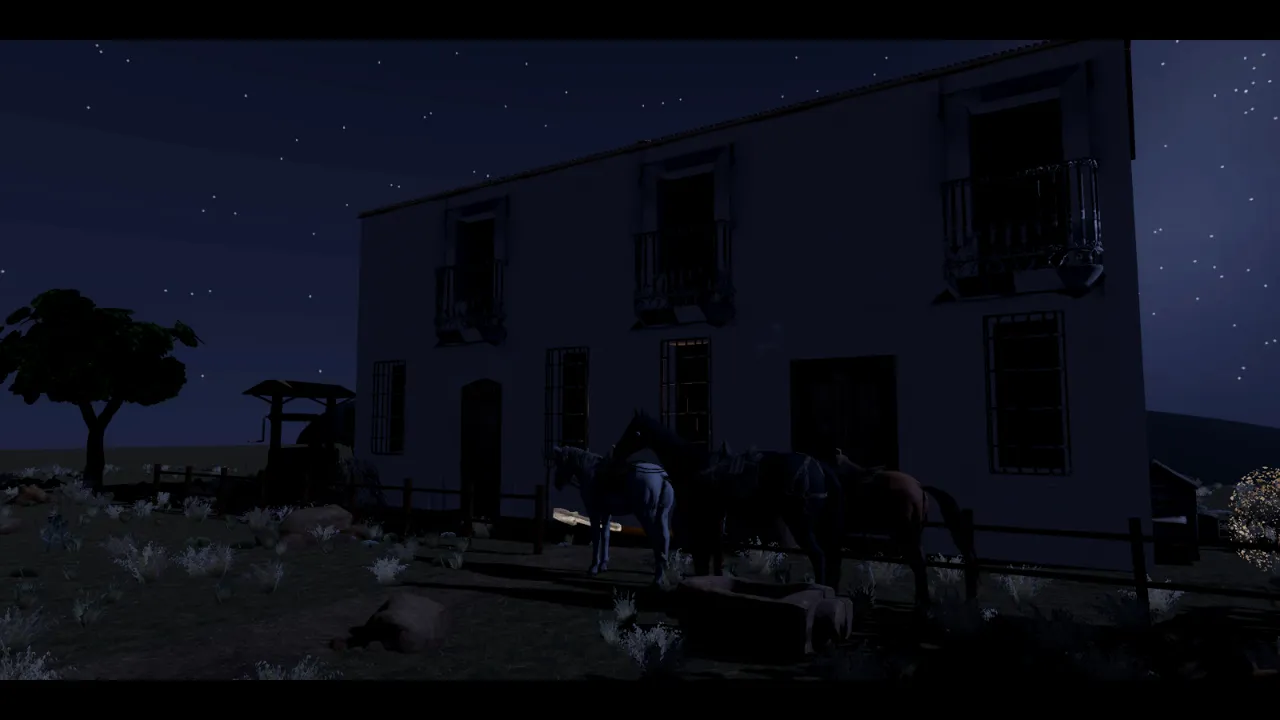
The game now opens with a short film made in the engine: a night at the family house in Catalonia, October 1678, twelve years before the story starts.
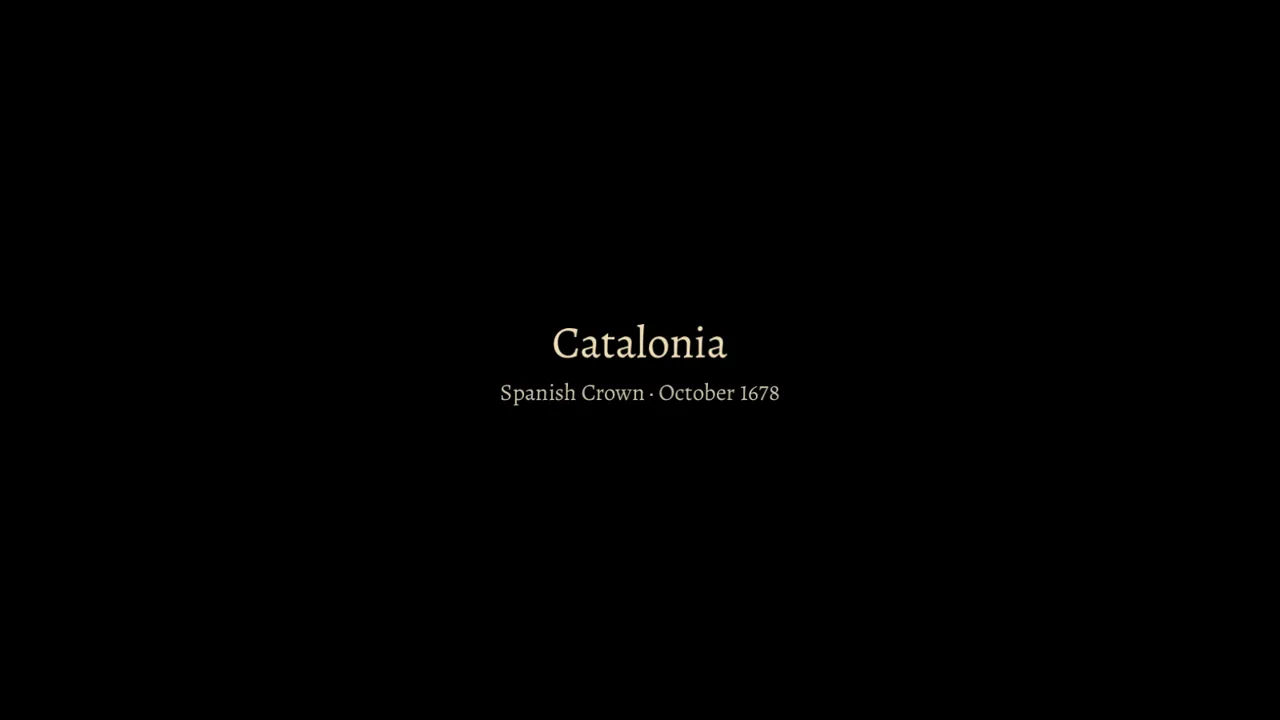
It begins on a black screen with the place and the date, then cuts to the house under a real night sky for that date.
People in the film sit, breathe and look at each other more naturally, with faces that react to what is said.
A new review loop checks every frame of the film, the poses of the people and the light, before a version goes out.
The title card that opens the filmThe house at night
The demo route
The demo now runs through three places: your home village, Manresa and Barcelona, and it ends in Barcelona.
Side jobs that used to wait in Vic now start in Manresa: at the tavern, at the stables and on the market square.
Notice boards and jobs from towns outside the demo no longer show up in it.
After the end of the demo, the journal says what comes next in the full game.
Trade between towns
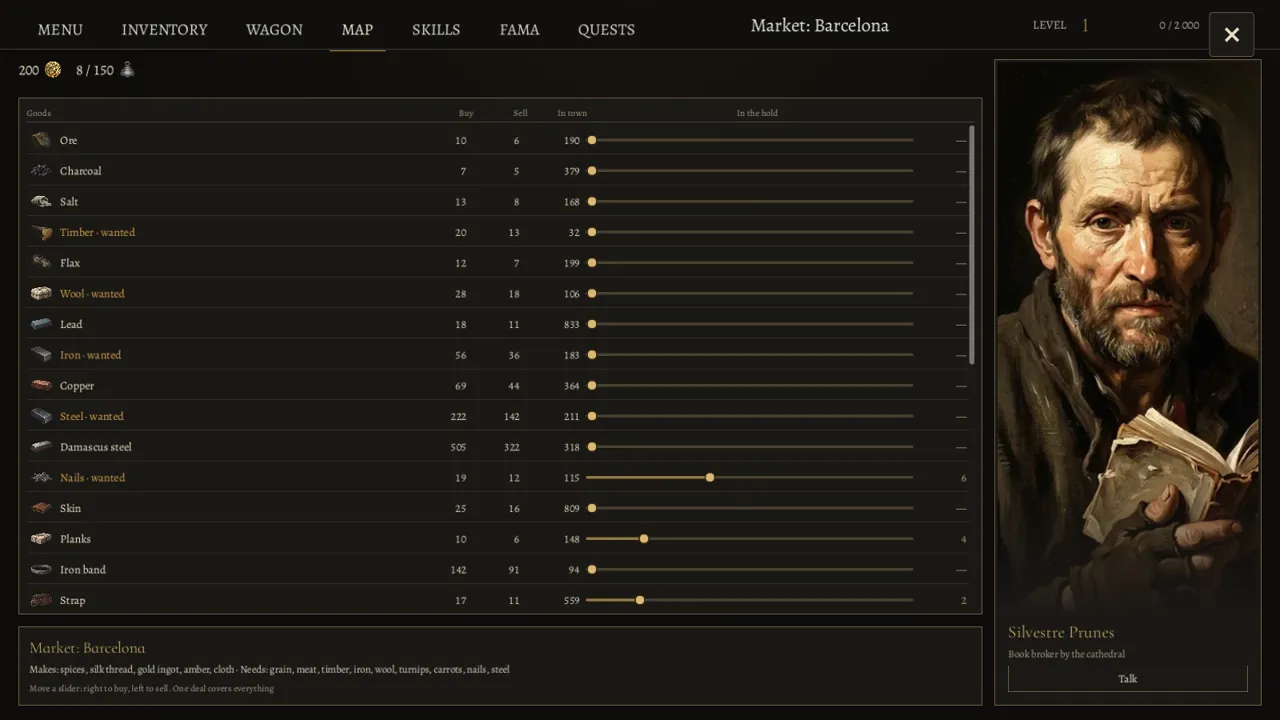
Barcelona sells cloth and buys nails and steel for its shipyard.
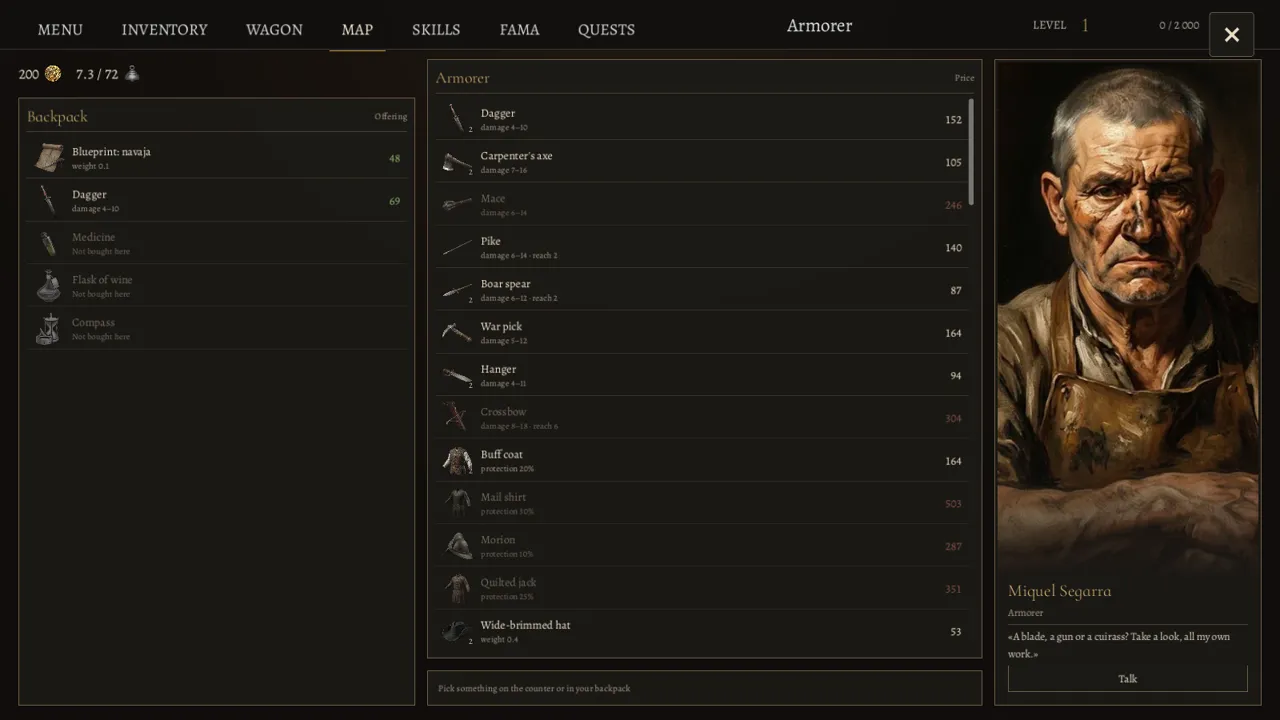
The armorer in Manresa sells simple gear. Swords and firearms are sold in Barcelona.
This entry covers October 28. Most of the day went into the screens you use all the time: the menu, the map, the signs that tell you where to go, and how the game reads on a phone.
One menu everywhere
The menu is now the same on the map and in every location, with the view, the sections and the game options grouped together.
On desktop the menu is the first word in the top bar. On phones it sits in the same row as the place name.
The plus and minus zoom buttons moved into the menu, so they no longer cover the scene.
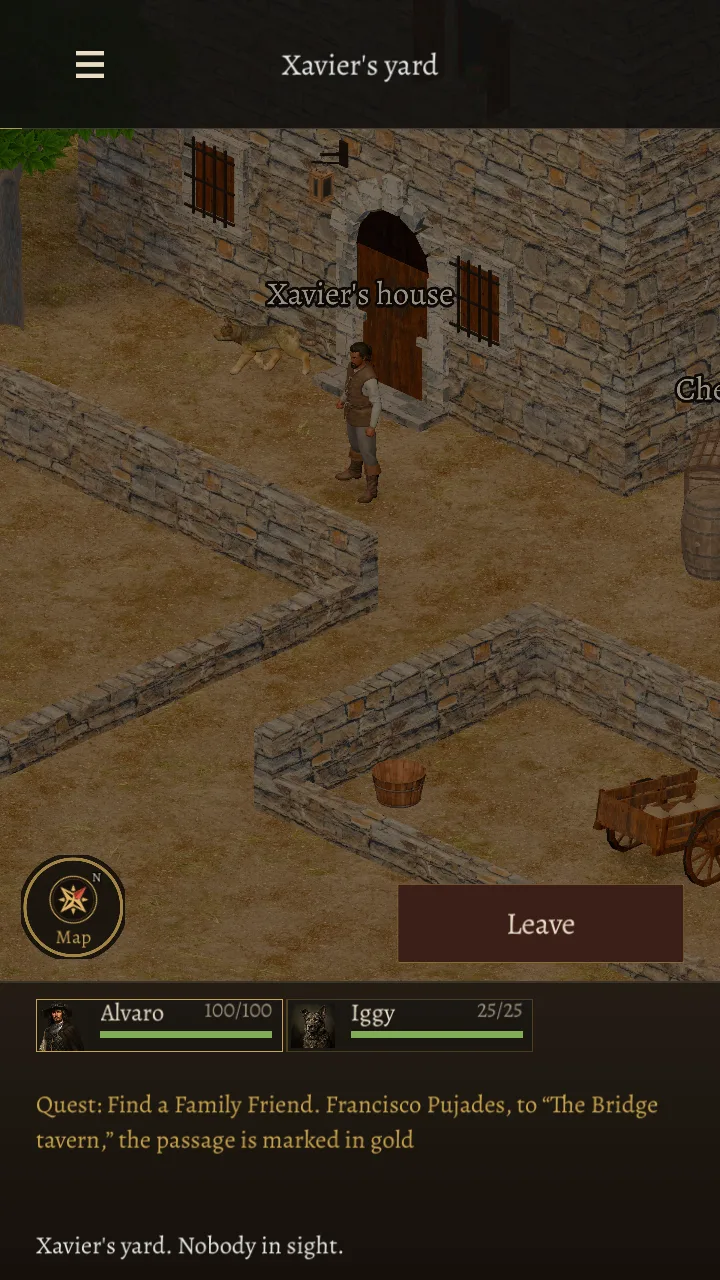
Names above people are always on, and the labels over exits and doors are shorter, with a small icon. A locked door now says so above it.
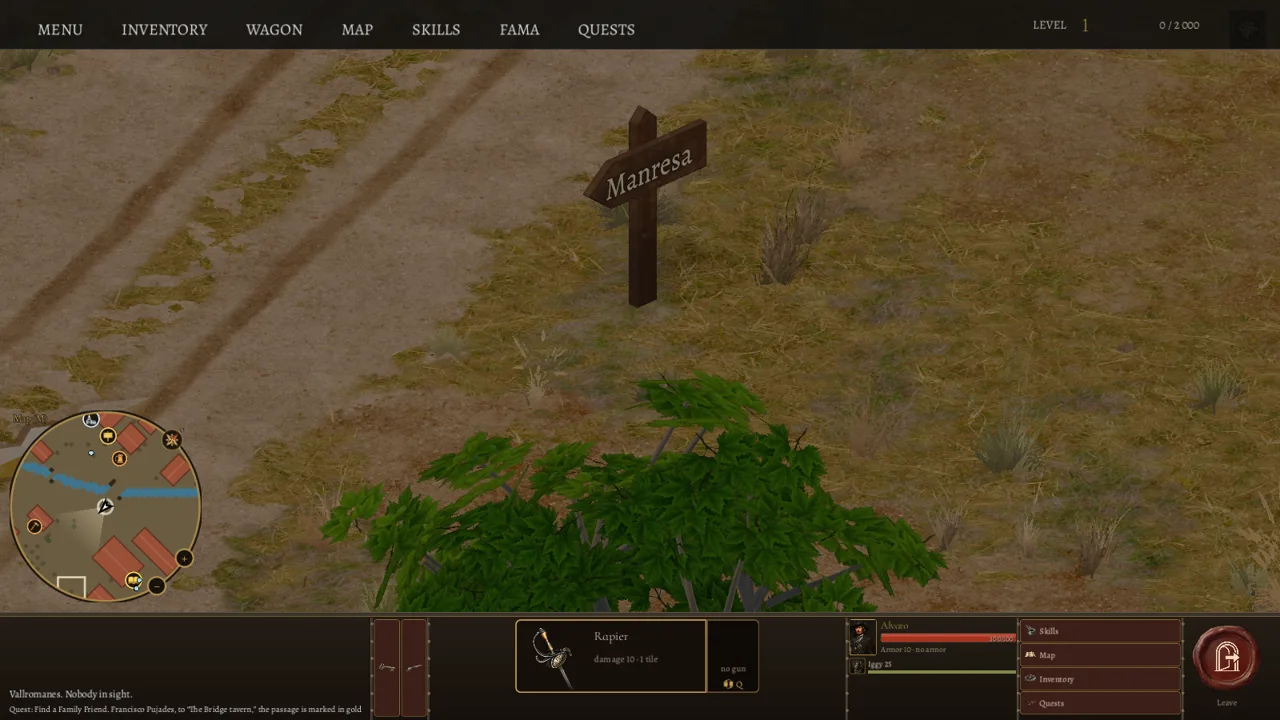
A signpost on the road out of the village
The map
The list of known places fits the screen. Every place has its own Travel button, and its details open when you tap it.
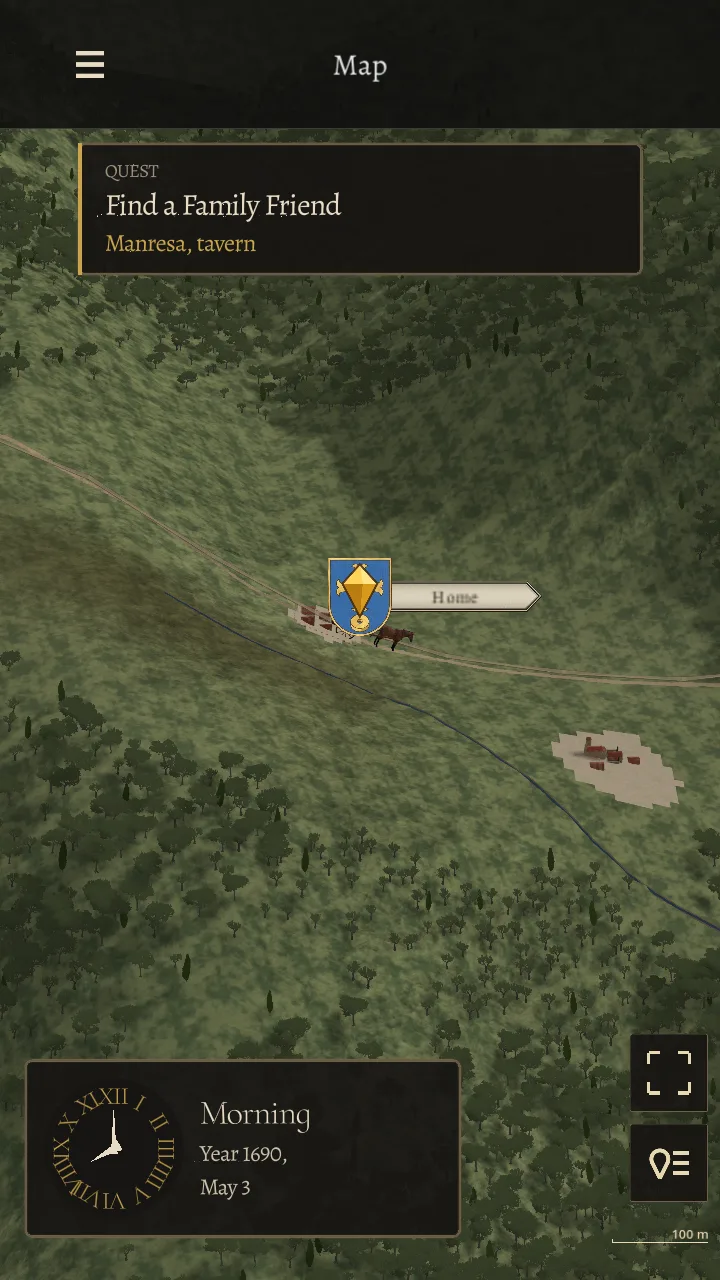
The clock and the quest card are larger and sharp on phones, and the quest card sits in the middle.
When you leave a location, the roads near the wagon are already drawn. The loading screen waits until they are.
The overview and known places buttons are now small squares with an icon in the corner.
The map on a phone
Getting around
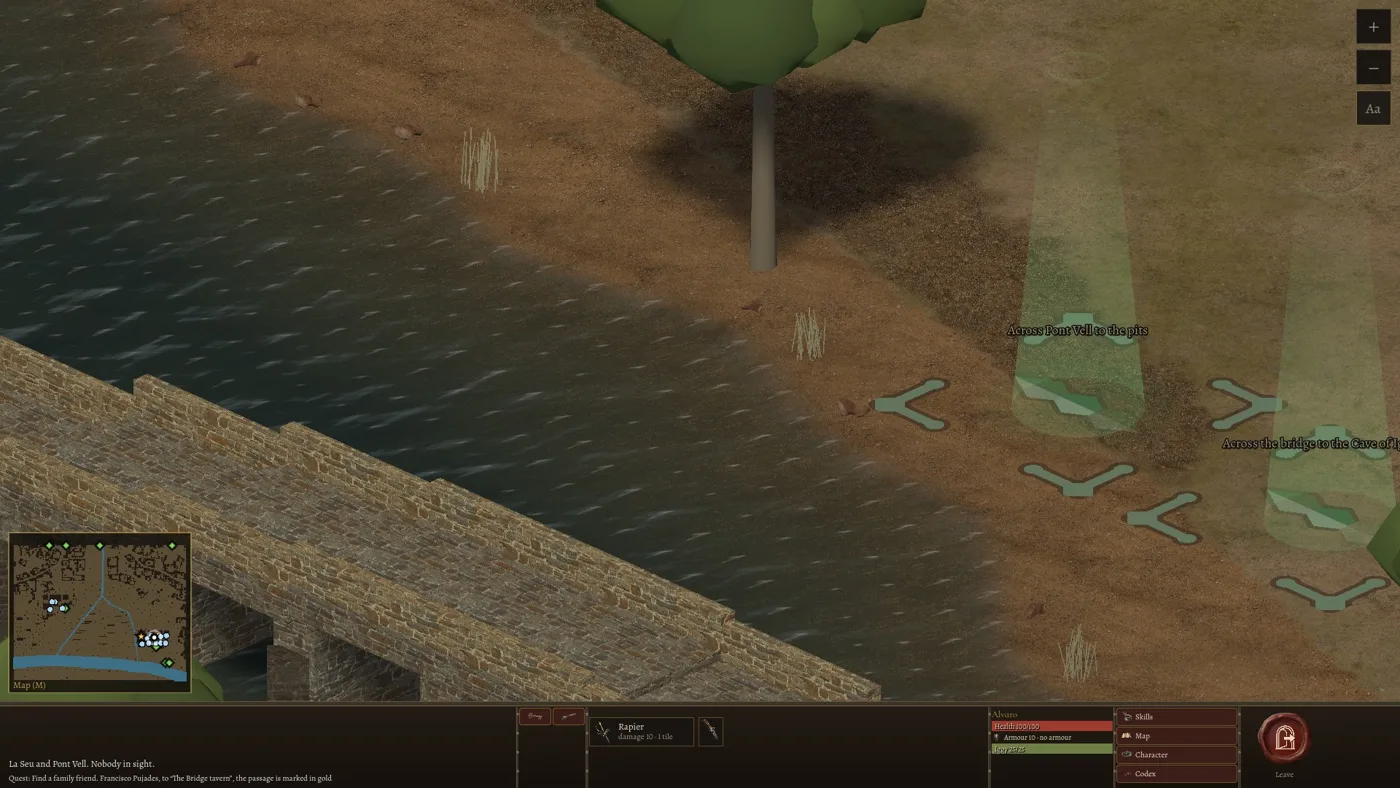
Exits are marked with a gold arrow and a short label. The exit zone shows only when you point at it.
Before you leave for the road, the game asks once and saves your progress.
Signposts in the village point at the places they name, and the text sits in the middle of the board.
The village got a round of fixes: fences meet at the corners, the coops are full size, and a ladder no longer hangs in the air.
Names above people on a phone
Skills and perks
Perks now open from level 3, and skills work on their own as they grow, without extra steps.
Trade and craft skills give clear, small bonuses in shops and at the forge.
The defeat screen and the skills screen use the name you chose for your hero.
This entry covers October 24 and 25. The hero's home village was laid out again, everyone in it got a face, and the shops, the map and the hero's own stride got a round of care.
The village, rebuilt
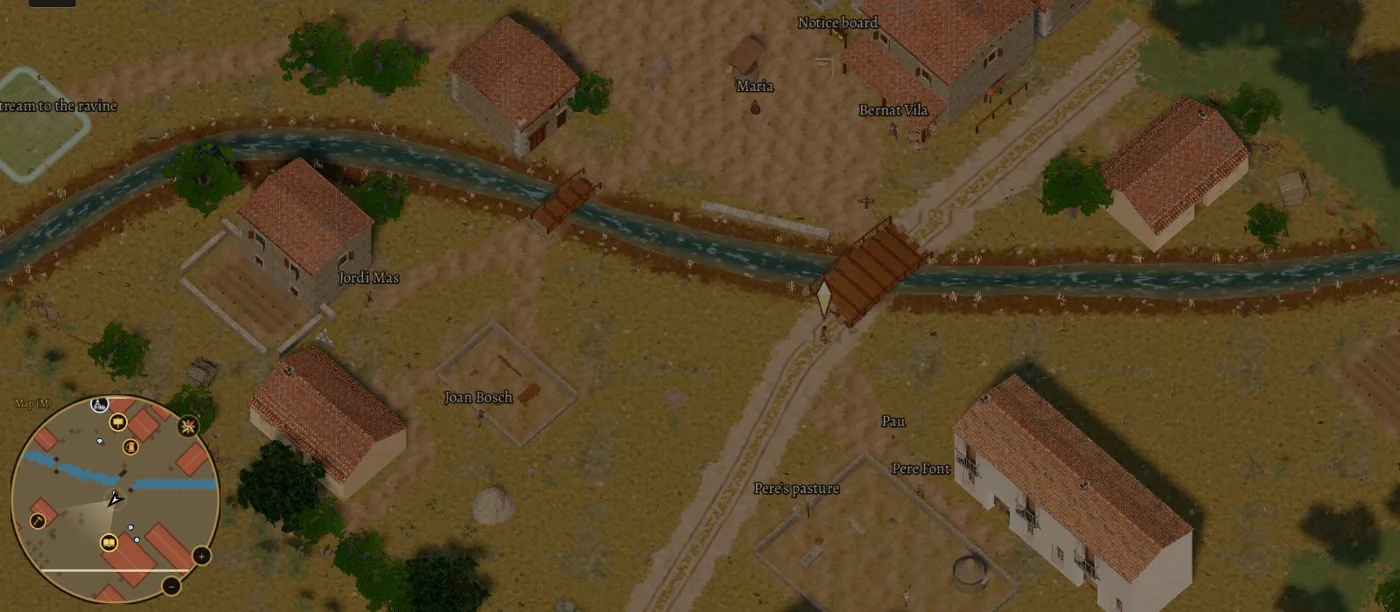
The village now sits on two sides of a stream, joined by bridges, instead of one crowded square.
Every building has its own person: the priest by the church, the healer by his herb beds, the carpenter by his workshop.
The church is now stone and red tile, the same height as the houses around it, with dark windows and a door that faces the path.
The village by the stream
Faces to talk to
Everyone in the village now talks to you with a living head, and behind each of them you see their own corner of the village, not a dark backdrop.
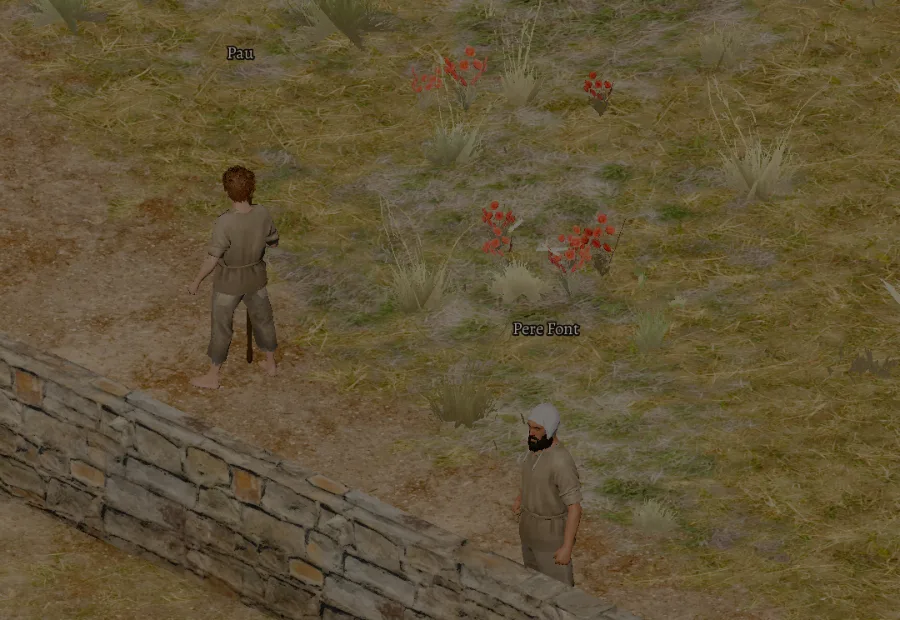
Pau, the young shepherd, has his own figure and face: shorter than the grown men, in his own shirt.
Maria has a new model. In conversation she looks straight at you.
Pau in the village
Shops and screens
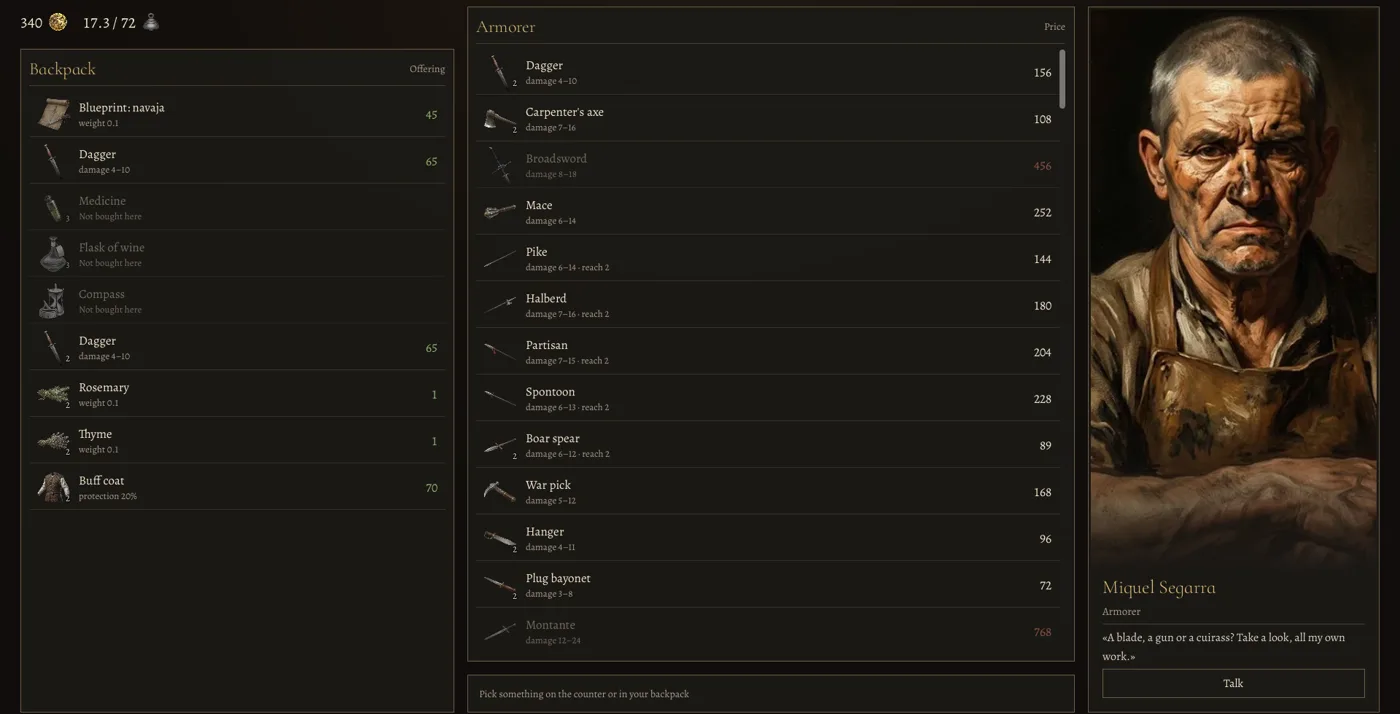
Shops have a clear layout: your things on the left, the goods in the middle, the merchant on the right. Columns keep the same width on every screen.
The fame screen shows your standing with the four powers as four cards, each with its own wax seal.
On phones the save window fills the screen, and dates read plainly.
A shop in town
On the road and in town
The hero walks heel first now, with the toes lifting as the leg swings forward.
Leaving a town takes you around its walls to the gate, so the wagon no longer ends up across a river from Barcelona.
The minimap shows a frame for what the camera sees, and the camera no longer gets in your way when you look around.
The port of Barcelona was tidied up: boats sit on the water, not over the sand.
In Vic, four people now share rumors: the tavern keeper, the guild master, the fence and the mule driver.
Several landmarks read better from the road, among them the castle of Mur and the salt mountain of Cardona.
This entry covers October 23. The landmarks on the world map became real places you can see, and the roads finally meet the bridges properly.
Landmarks you can see
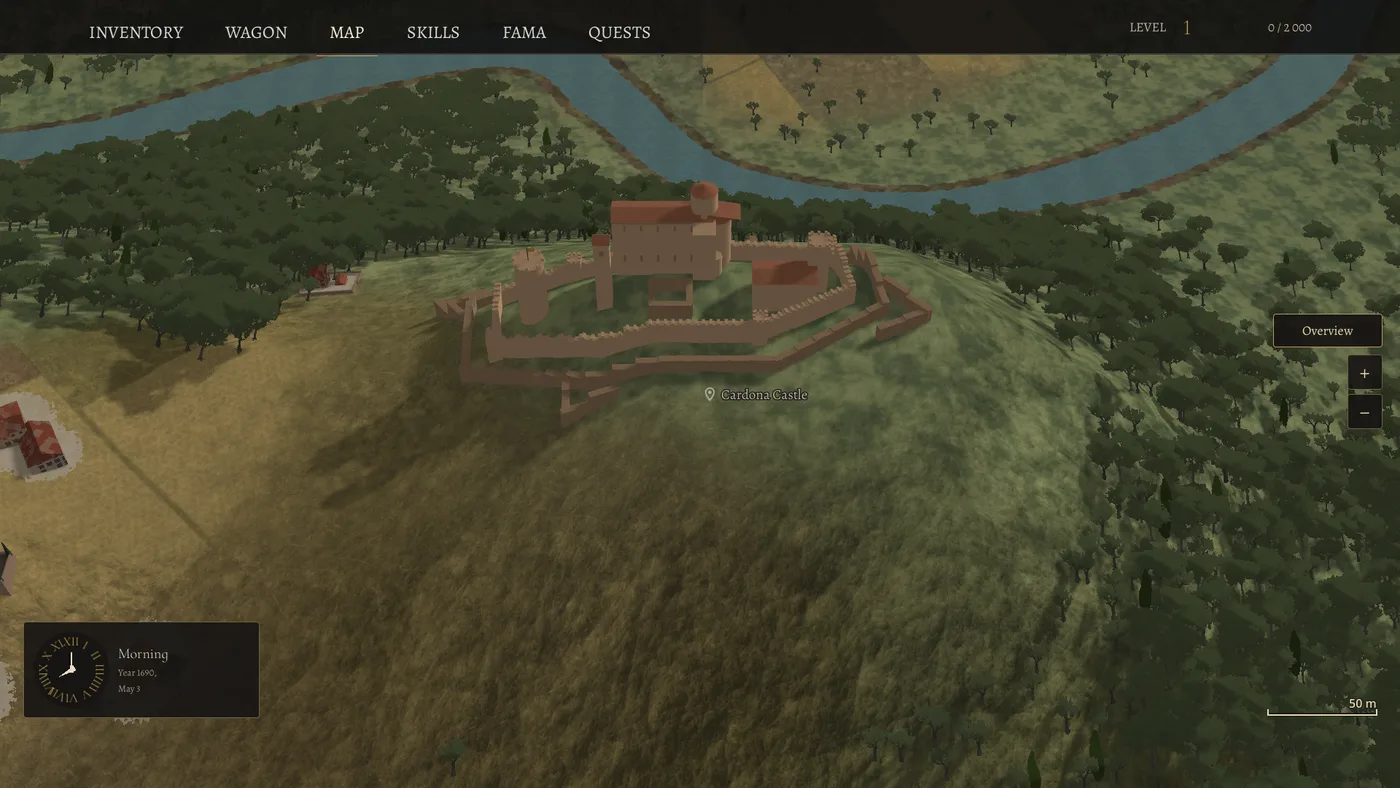
Landmarks are no longer just icons. Castles, monasteries, towers and bridges now stand on the map as small 3D models, and famous mountains get a golden outline on the terrain.
Each model was rebuilt from photos of the real place: the castle of Cardona on its hill, Miravet over the Ebro, the arch of Bera on the Roman road, the Tower of the Scipios, Siurana on its cliff, Tamarit right by the sea, and many more.
The monasteries of Poblet, Santes Creus, Sant Benet and Casserres each got their own features.
A castle on the world map
A sketchbook of Catalonia
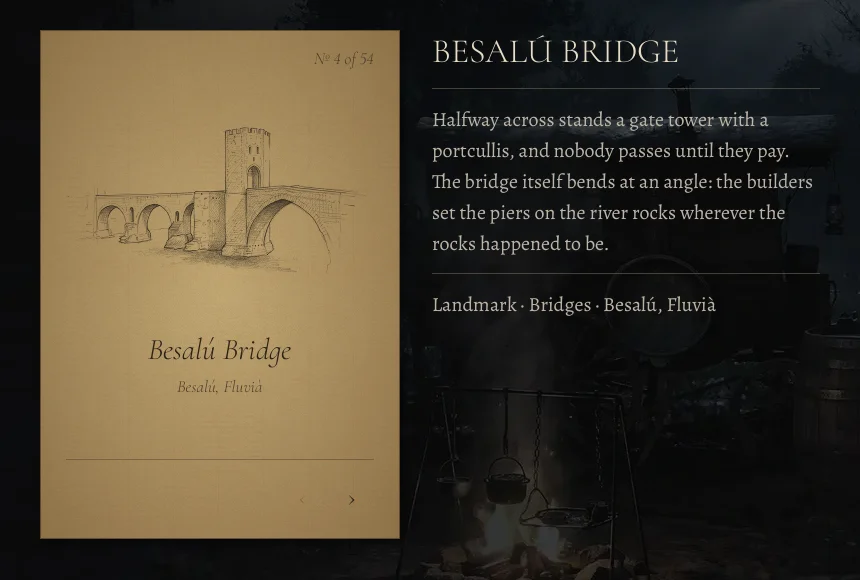
Every landmark you find now gets a page in the codex: a pencil sketch of the place on a sheet of paper, next to the hero's short note about it. All 54 places have their own sketch.
A landmark sketch in the codex
Bridges and ferries
All 607 bridges on the map now sit right on their roads. The road runs straight onto the bridge and off the other end, with no stubs hanging in the air.
Where a road used to cross the middle of a reservoir, it now goes around it or takes a ferry from shore to shore.
Also changed
Women in towns now have their own figures and dresses instead of placeholder models.
A new compass drawn from an old wind rose, and the map icons come from one consistent set.
The notice board is built from planks, with notes pinned on different kinds of paper.
On phones held upright, loading screens show a bigger saying and keep the picture centered on what matters.
Coming back to the world map takes about 3 seconds again instead of 8.
This entry covers October 22. The world map now rewards curiosity, and the first hours of the game got smoother.
54 landmarks across Catalonia
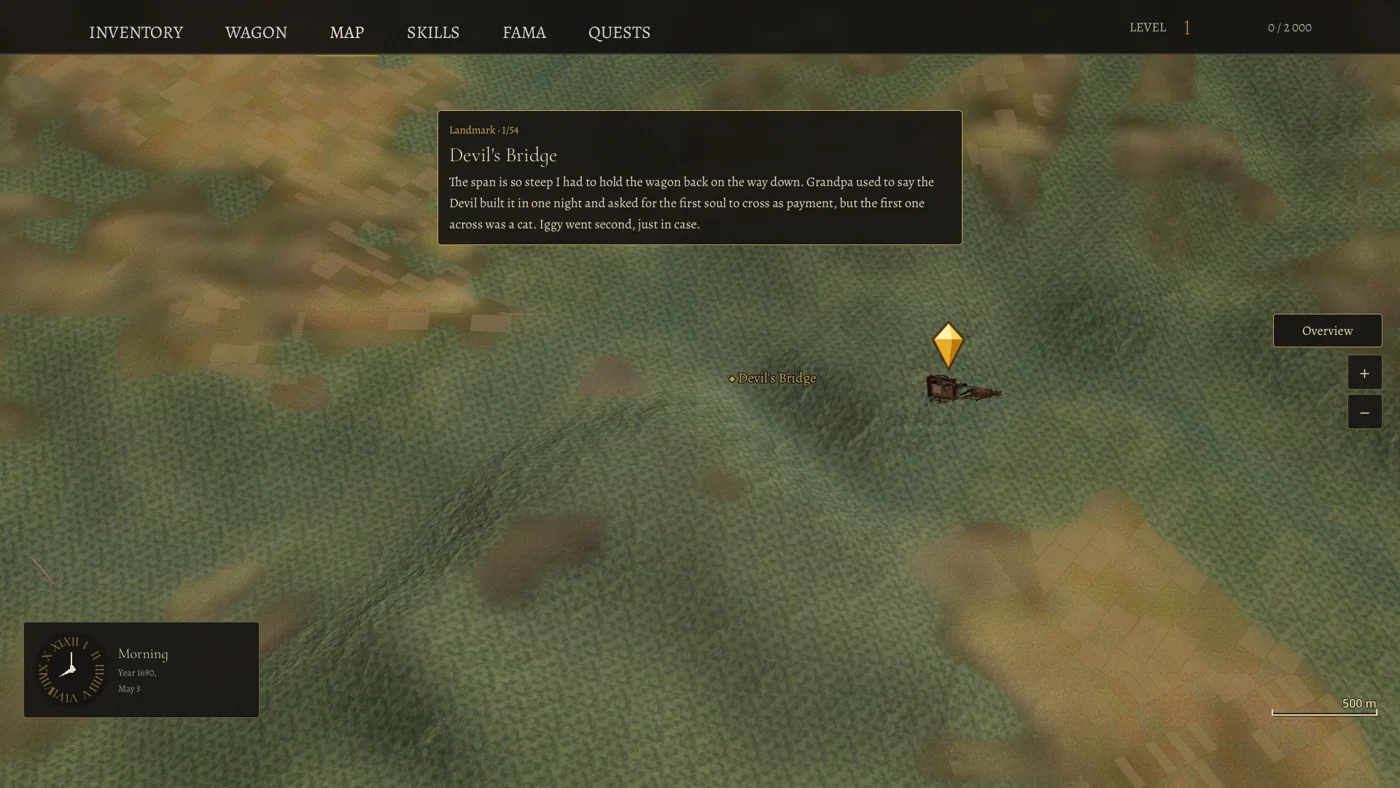
Bridges, mountains, castles, monasteries, hermitages and ancient ruins are now marked on the world map, from the Devil's Bridge in Martorell onward. There are 54 of them, all placed where they really stand.
Drive the wagon close to one and it counts as found. The hero writes down a short impression in the journal, and a counter shows how many you have seen.
Found landmarks are labeled first, so the map slowly fills with the places you have been.
A landmark on the world map
Look around the map freely
The map camera is no longer tied to the wagon. Drag with the mouse or a finger, or use the arrow keys and WASD, to look wherever you like. The "Back to wagon" button brings the camera back.
Up close, roads are drawn as a dirt track. Further out they turn into clean map lines, and the switch between the two is now smooth.
Clearer minimap
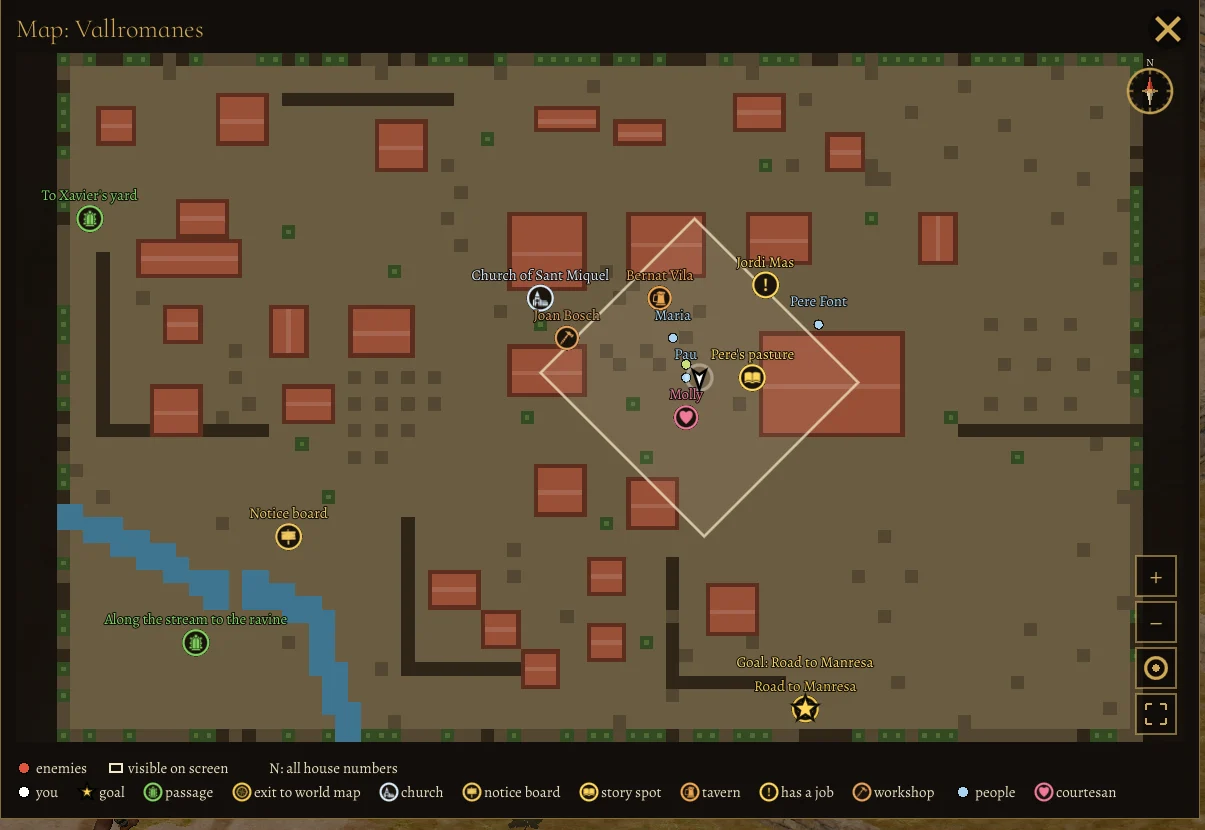
The icons on the minimap were redrawn: scales for the merchant, an anvil for the smith, a tankard for the tavern, a church, a tower and more. They sit in the center of a thin ring and read well even at small size.
The new map icons in the village of Vallromanes
Also changed
The tutorial only opens the path to the current goal, and the camera turns to the next person or door once per step.
The first fight takes place on an open field, without trees and bushes in the way. In every fight, leaves and bushes now thin out in front of all fighters, not only the hero.
Sunny days look warmer in the light and cooler in the shade.
The loading screen appears before the old scene disappears, so moving between places no longer flickers.
On phones the camera keeps the hero in the middle of the screen.
This entry covers October 21 and 22. The road between towns is no longer just a corridor between fights, and villages now have work for you.
Things happen on the road
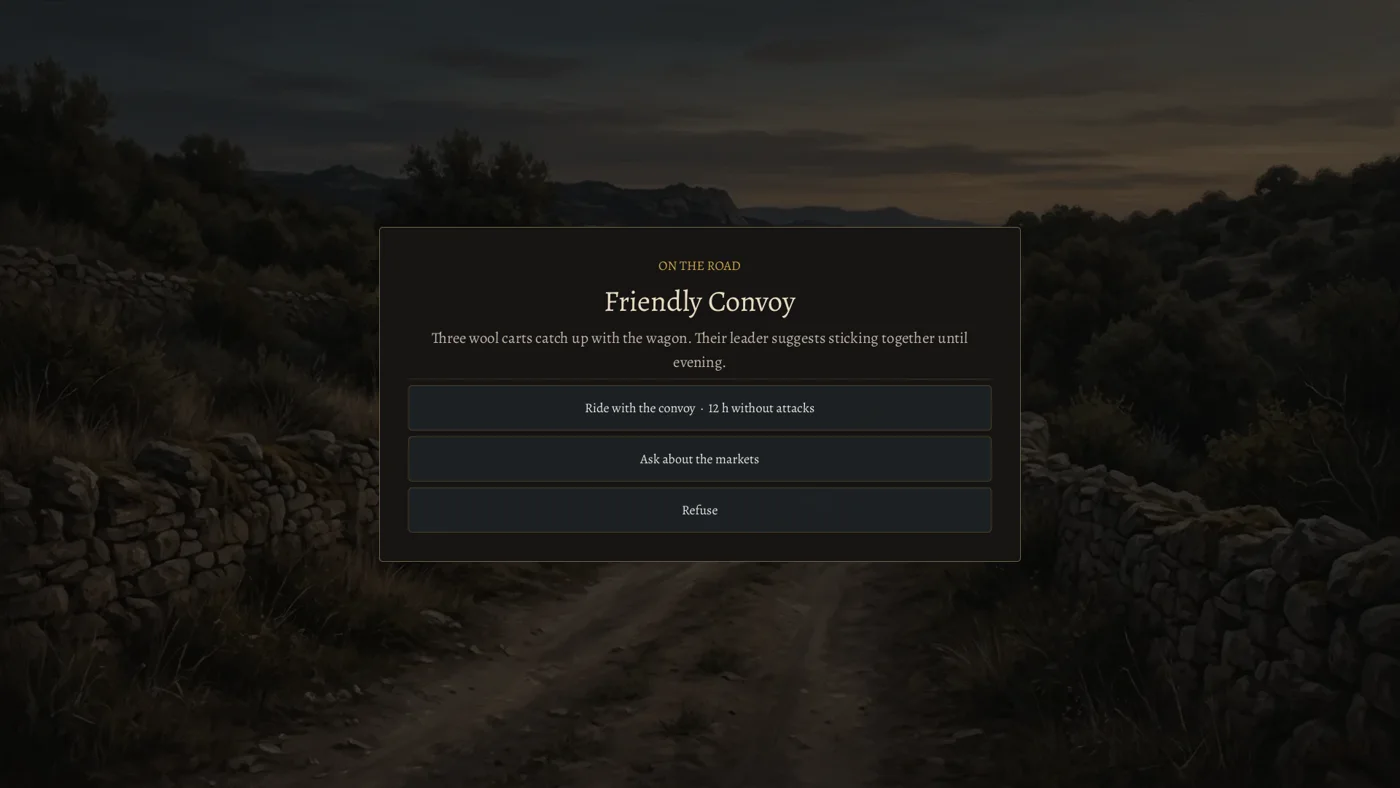
A stop on the map used to mean a fight. Now about half of the stops are something else: a spring by the road, a lost purse, refugees, a deserter.
There are 23 ordinary road events, and none of them repeats within three days. Some of your choices come back later: the people you helped or robbed may cross your path again.
A few rare encounters can happen only once per game. How often you meet them depends on your Luck.
The road is kinder at the start: your first stop is always a spring, and the first two cost you nothing.
A friendly convoy on the road
Notice boards and errands
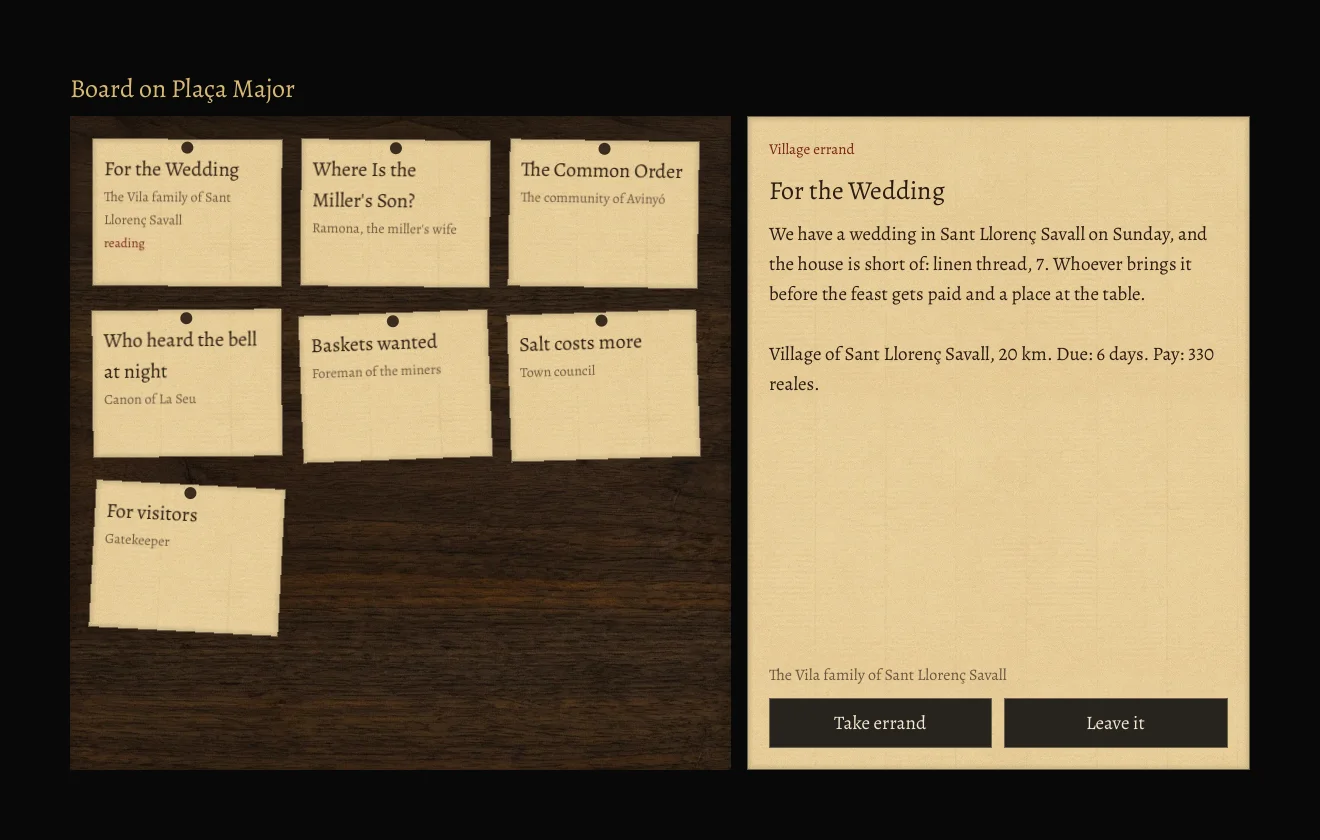
The boards in Manresa, Vic and your home village now hold errands that send you out to the villages around them: deliver a parcel, bring goods, ask around, or track someone down (alive pays double).
Every errand has a person behind it and a turn where you choose. Some of them echo a week later.
A village with an errand gets a seal on the map, and its stop card shows the job.
The notice board in Manresa
What people call you
The fame screen has a new section, "What they say about you". There are 21 nicknames to earn, from The Merchant of the Rambla for a good trader to A Thousand Roads for 10,000 km behind the wagon.
Also changed
Travel in the overview is slower and calmer: Manresa is about 30 seconds away. Hold Space or the Faster button to push the horses into a gallop.
The minimap in towns is round now, with a view wedge showing where you look.
Nine new loading screens: the castles of Montgrí and Mur, Montserrat, the trail to Núria, Cap de Creus, the Devil's Bridge and more, each with a Catalan saying.
When you create your hero you can pick an athletic or a lean build.
Leaving a town puts the wagon right at its gate, not miles away.
This entry covers October 18 through 21. The world map got its towns, its villages and its roads, and the wagon learned to stop on the way.
Towns of 1690
Every major town on the map now stands inside its walls as they were around 1690, with towers, gates and suburbs outside. Barcelona follows a plan from 1697: the sea wall, the mole with its lighthouse and ships in the harbor.
Cathedrals, churches and palaces are built from their real outlines, each with its own stone, roof and paved square. Squares hold markets, wells and fountains.
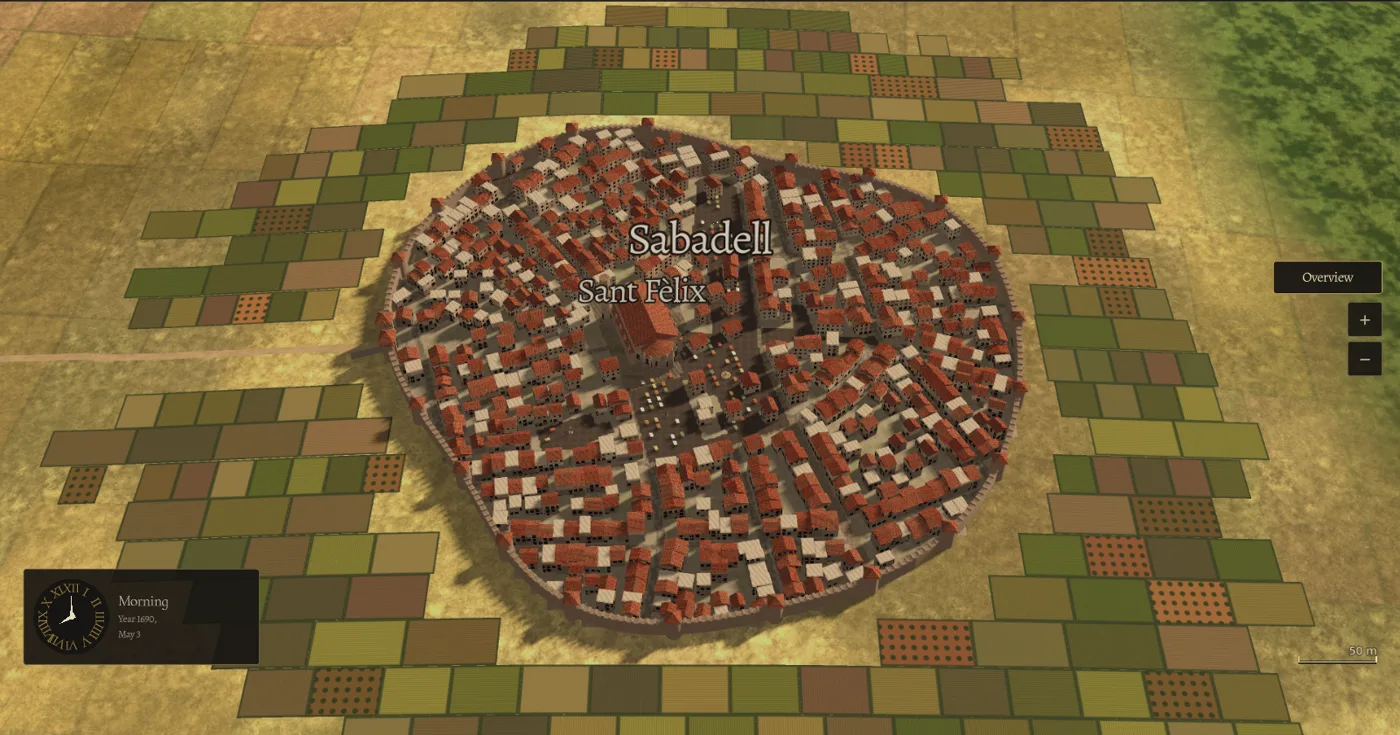
Eighteen more towns appear on the map, among them Tortosa, Reus, Mataro, Sabadell and Terrassa. Inside their walls the streets are filled with houses, and gardens and orchards ring them outside.
Sabadell inside its walls, with a road leading to the gate
Over 1,400 villages, each one different
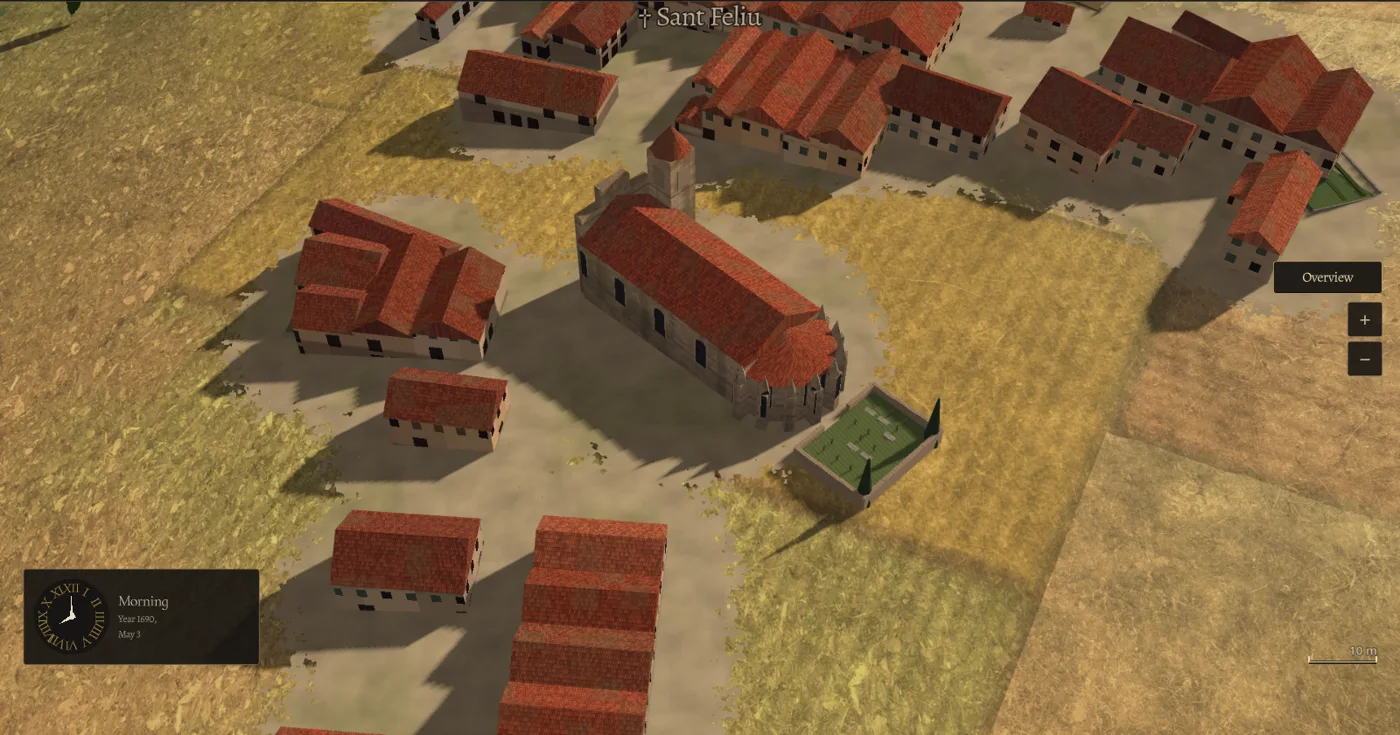
Villages used to share one layout. Now each is built from the real old core around its parish church, taken from OpenStreetMap: the houses, their sizes and how they face each other.
Every village has a church with an apse and a bell tower, a small walled cemetery, vegetable plots behind the outer houses and walled farmsteads around it.
The ground under a village is light, trampled earth that frays into the grass.
Village and church names float above each one when you zoom in.
Monistrol de Calders: houses around Sant Feliu, the cemetery behind the apse
Stopping in a village
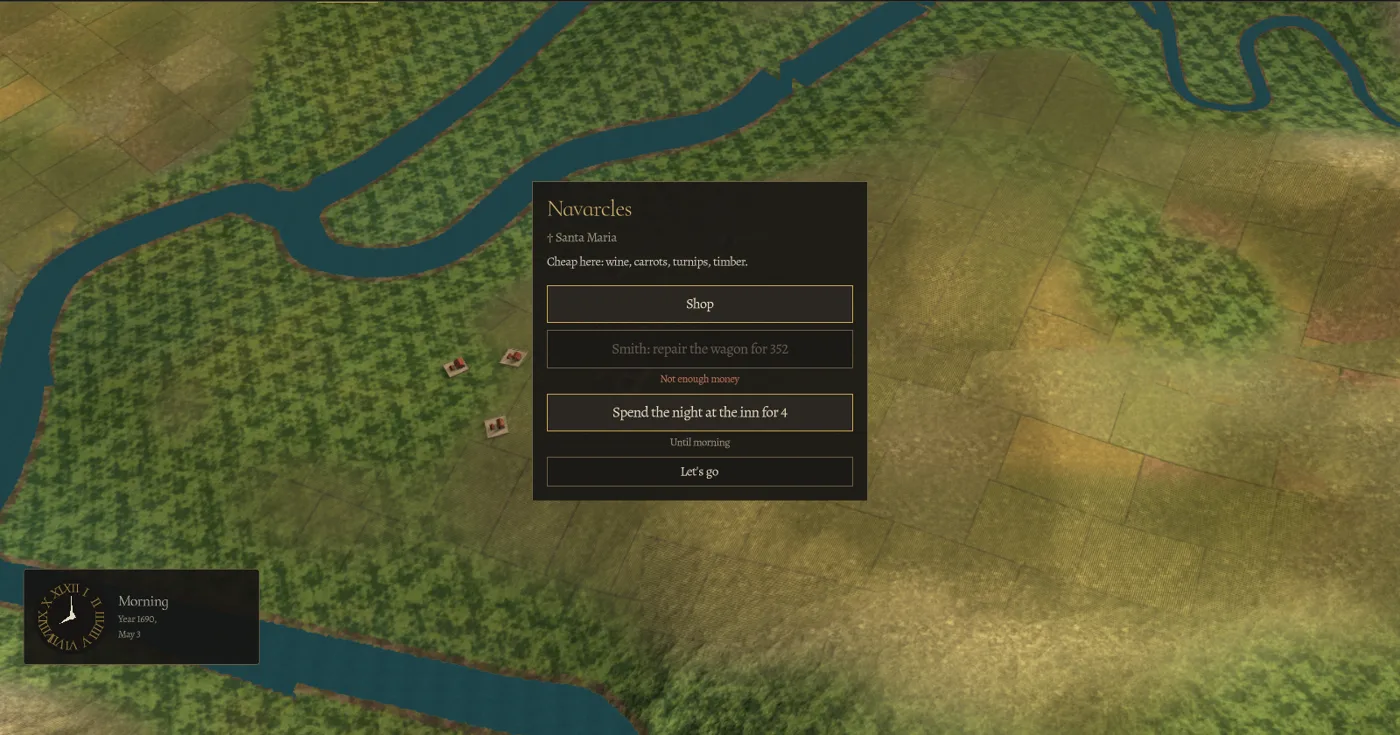
Click a village and the wagon pulls up by the church. A card shows what is cheap there, a rumor from the inn, a small shop, a smith who repairs the wagon and a bed for the night.
Each village sells what its land gives: wine near vineyards, oil near olive groves, wool and meat from pastures, timber and charcoal from the woods. It pays more for what it lacks, like nails, salt or cloth.
The stop card in Navarcles
A map from the road and from above
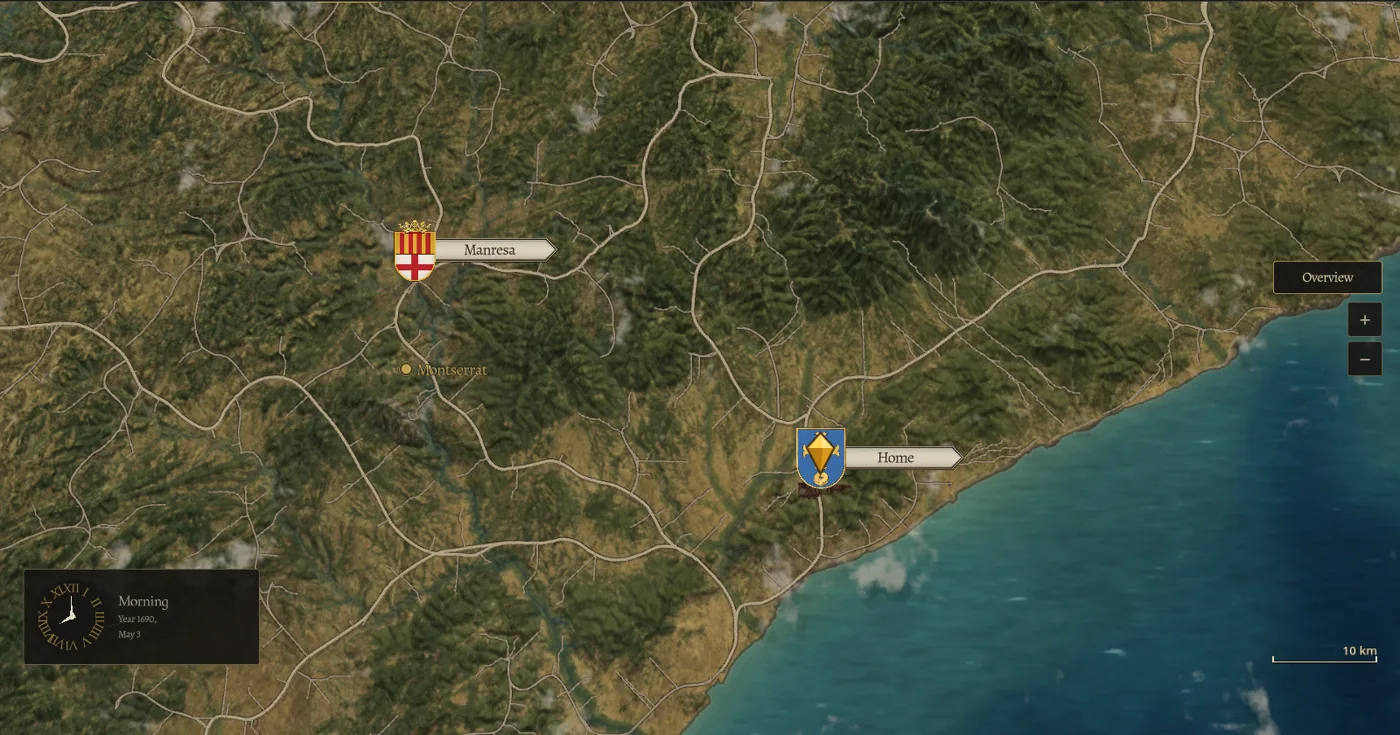
The map now has two views. From the road you see about a mile and a half across, with the wagon in the middle. The overview shows the whole region for planning a route, and the camera flies between the two.
Clicking a destination no longer pulls the camera back to the wagon. The wagon drives on its own, and the camera only follows when it nears the edge of the screen.
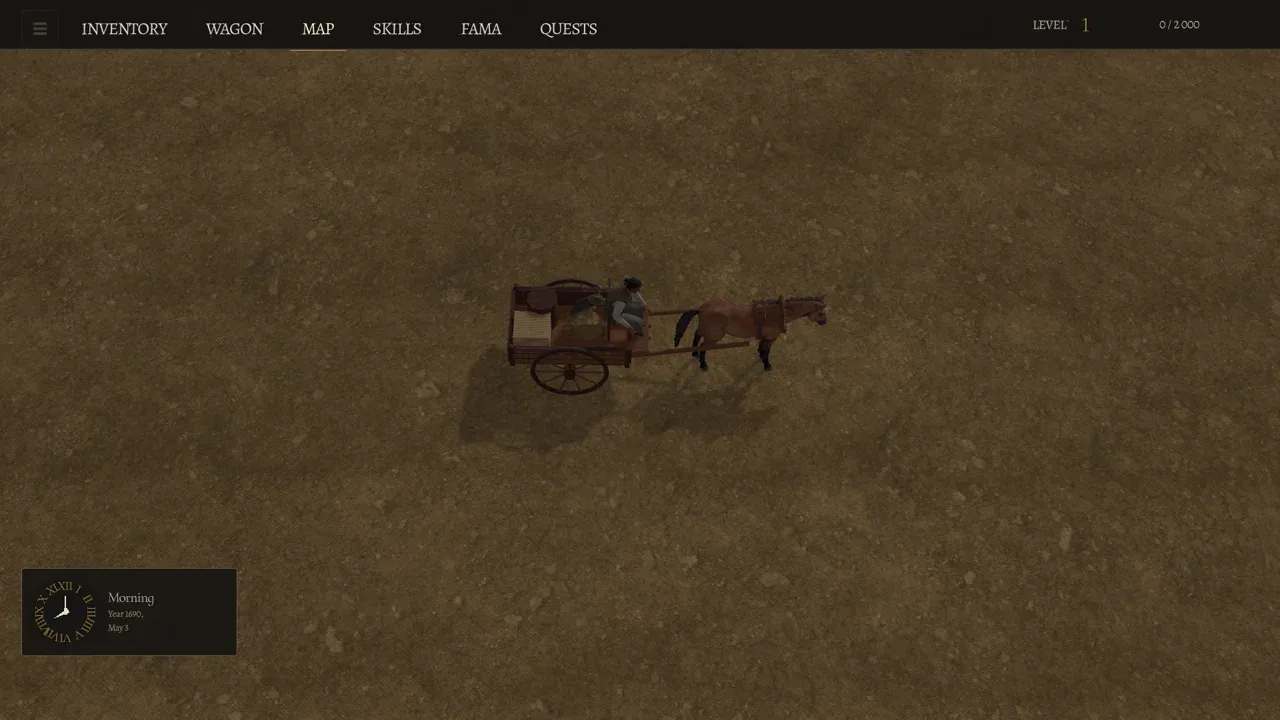
The land is split into 21 kinds of terrain, from wheat fields and vineyards to marshes, scree and snow. Off the road the wagon is faster on fields and pastures and slower on sand and in vineyards.
From far away roads are drawn as clean lines of even width, so you can see where each one leads. Main roads are wider than country lanes.
Every village and town now has a road or a lane leading to it, with small bridges where it crosses a stream. Roads no longer run into the sea or through rivers without a bridge or a ford.
The overview between Manresa and the coast
Also changed
The tutorial is shorter: 13 steps instead of 15. It hides while a menu or a dialog is open, and quitting it now asks you to confirm.
The map opens about four times faster. Towns are built one by one, nearest first.
A small golden crystal now marks the wagon on the map, the same one the tutorial uses.
This entry covers October 17 and the morning of the 18th. Almost all of it went into the world map: it now sits on the real relief of Catalonia, and you can zoom from the whole country down to your own wagon.
The map is now in 3D
The painted map lies on real Catalan terrain. Mountains rise, rivers run in their valleys, and the light falls on the slopes.
You can zoom from all of Catalonia down to the real size of the wagon. Up close you see fields with their furrows, olive and pine groves, rivers with gravel banks, and the sea with surf on the beach.
Unexplored land is drawn in ink on parchment, with clouds drifting over it.
Towns stand on the map as small models: blocks of houses, a cathedral, walls and gates.
Time follows the zoom. From far away the days fly by. At full zoom the wagon moves at its real speed, and the clock runs at real time.
The wagon on the road
The wagon is part of the world now. It stands on the slope, casts a shadow and follows the road.
A new horse with a fitted harness pulls it. Alvaro sits on the bench, and Iggy rides in the back.
Roads are drawn as dirt tracks with wheel ruts, not as dashed lines, and the wagon drives along them.
Alvaro and Iggy on the wagon, at full zoom
The ground decides where you can go
Every patch of land has its own pace: road, fields, scrub, forest, marsh and rocky slopes.
Climbing slows the wagon. Off the road it cannot climb a slope steeper than 15%, so it goes around through valleys, woods and roads.
When you set off, the map tells you how many hours the trip takes, how much you will climb, and which crossings you will use.
Rivers, bridges, fords and ferries
Big rivers like the Ebro, Segre, Llobregat and Ter can only be crossed at a bridge, a ford or a ferry. Streams can be crossed anywhere, just slower.
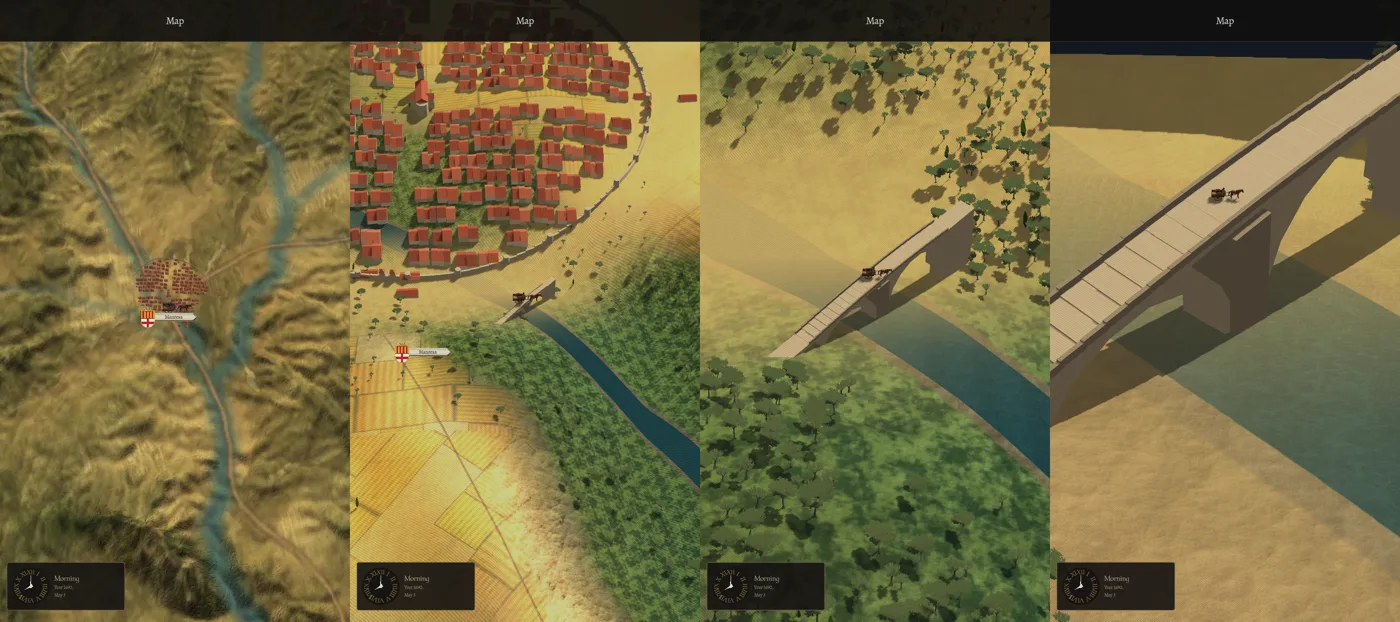
The real bridges of 1690 are on the map, among them the Devil's Bridge in Martorell and the Old Bridge in Manresa. The wagon rolls across the deck.
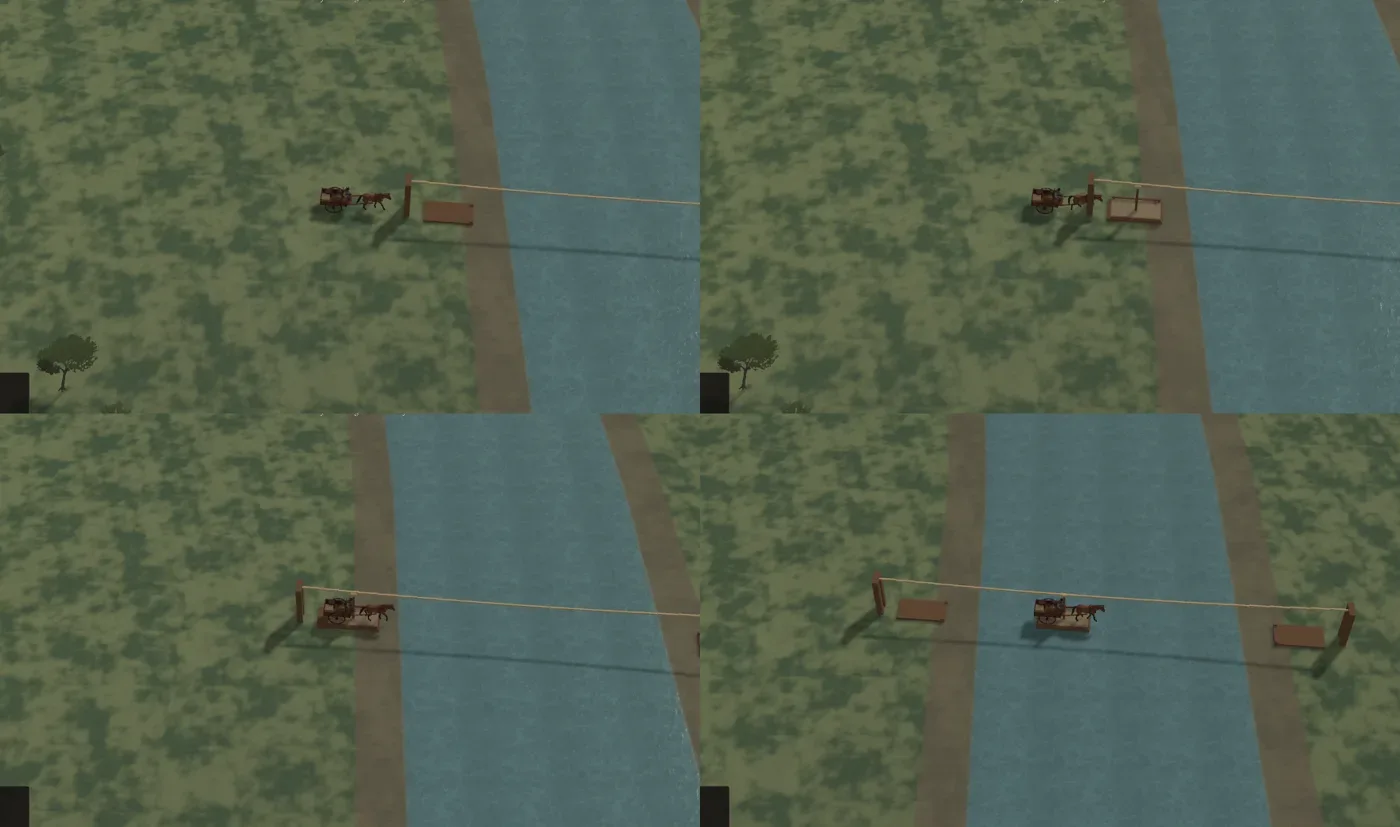
On the Ebro you wait for the ferryman. The raft comes for you, you drive onto it, and it carries you across on a rope.
The Old Bridge of Manresa, from far away to up closeThe Tortosa ferry: the raft comes over, the wagon boards, and the raft crosses on its rope
The coast
The shoreline winds the way it does in real life. Beaches have sand, wet sand at the water's edge, foam and shallow water over a sandy bottom.
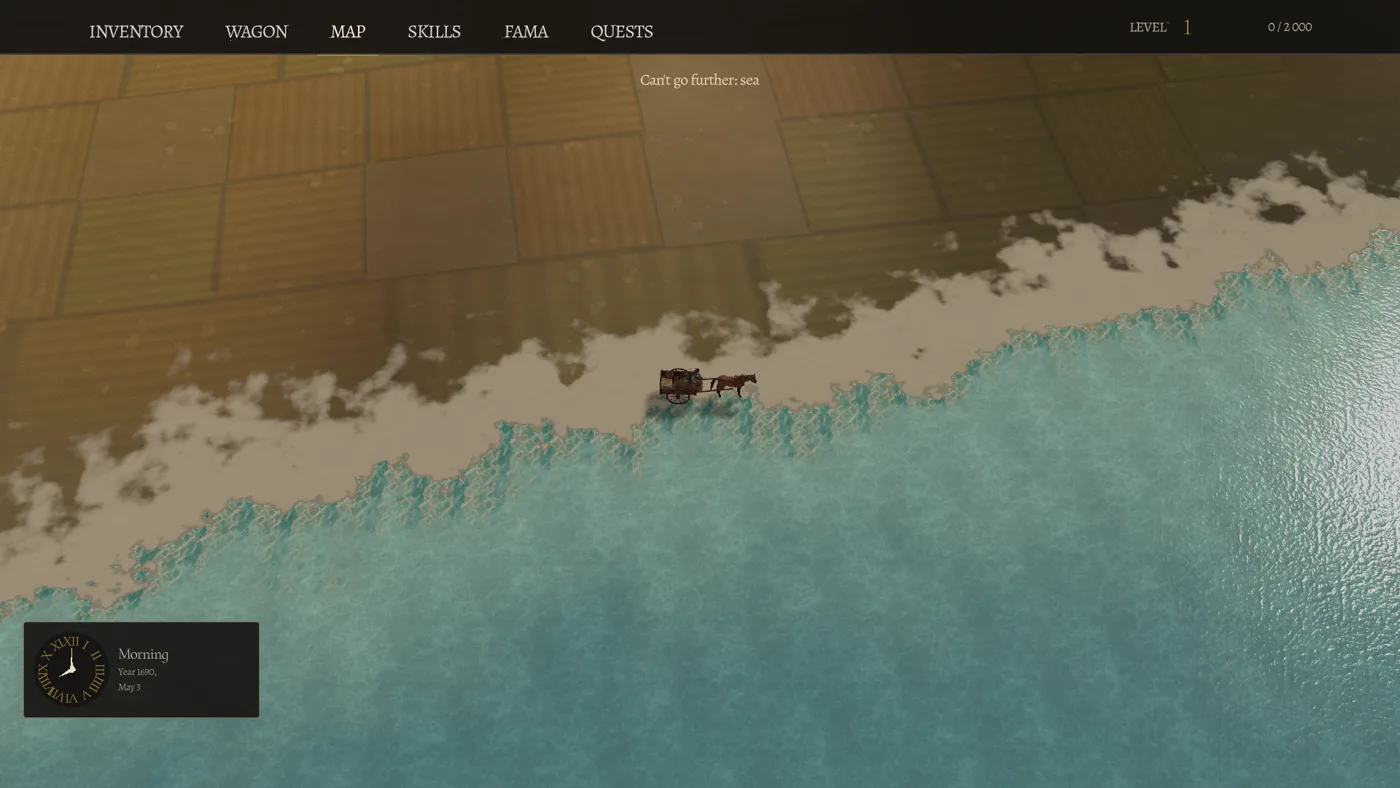
The wagon stops at the water instead of driving into the sea.
A beach south of Barcelona
Also fixed
On phones the map no longer disappears when you zoom in.
In the browser the land was washed out to a pale yellow. It now has its proper colors.
This entry covers two days, October 15 and 16. Most of the work went into the wagon, the herbalist's table, the forge and the market, so that money and supplies on the road start to matter.
A wagon that wears out
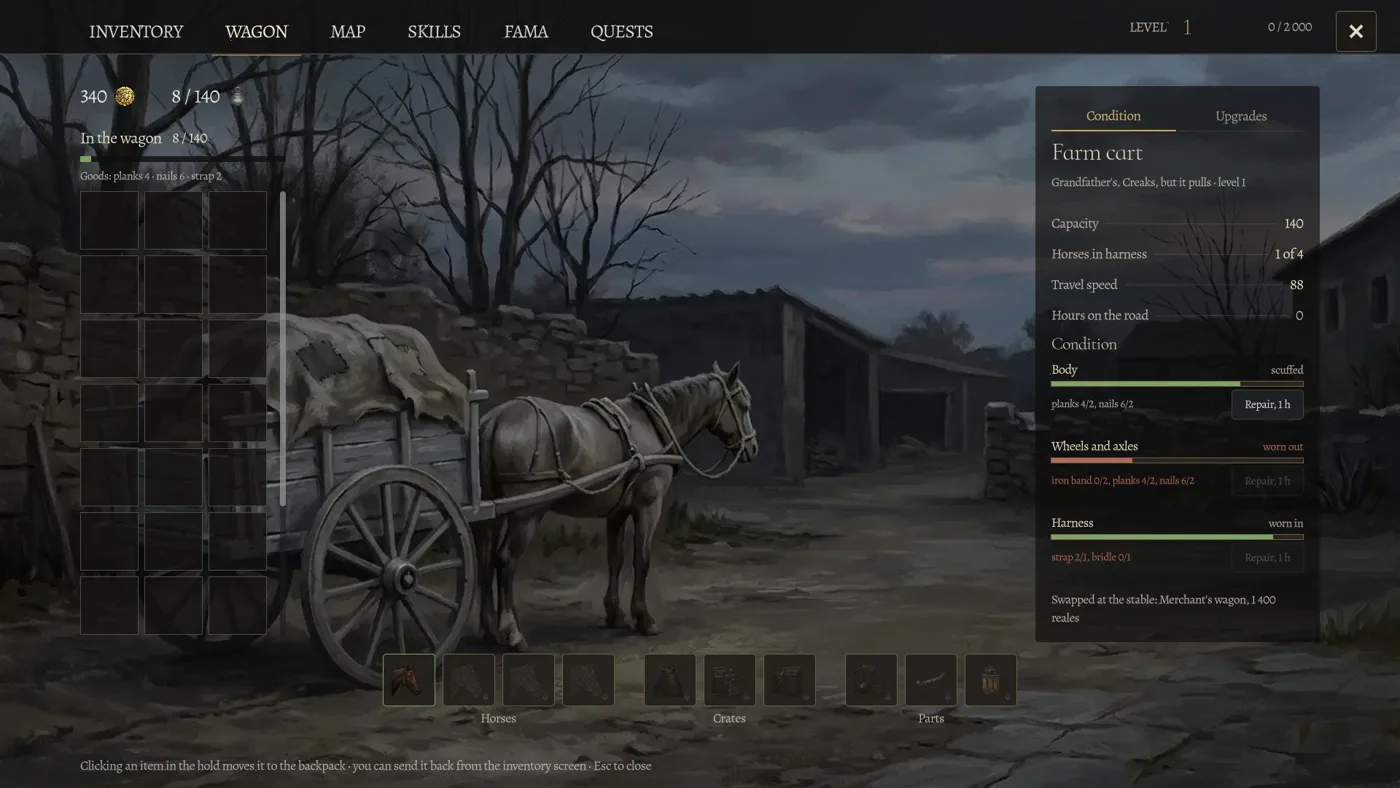
The wagon now wears out in three parts: the body, the wheels and axles, and the harness. Each one has its own bar on the wagon screen.
Worn wheels slow you down. A broken wheel can stop you on the road.
You can repair on the road if you carry the right parts: planks, nails, iron bands, straps. The forge and the market sell them.
On the world map the wagon is built from parts too: the body, the wheels, the shafts or the pole, the horses in harness, and the load over the sides. Damage shows on it.
The wagon screen: each part wears out on its own
Herbs grow back, and remedies that last a while
Herbs now grow back in three to ten days after you pick them. Mandrake takes a month.
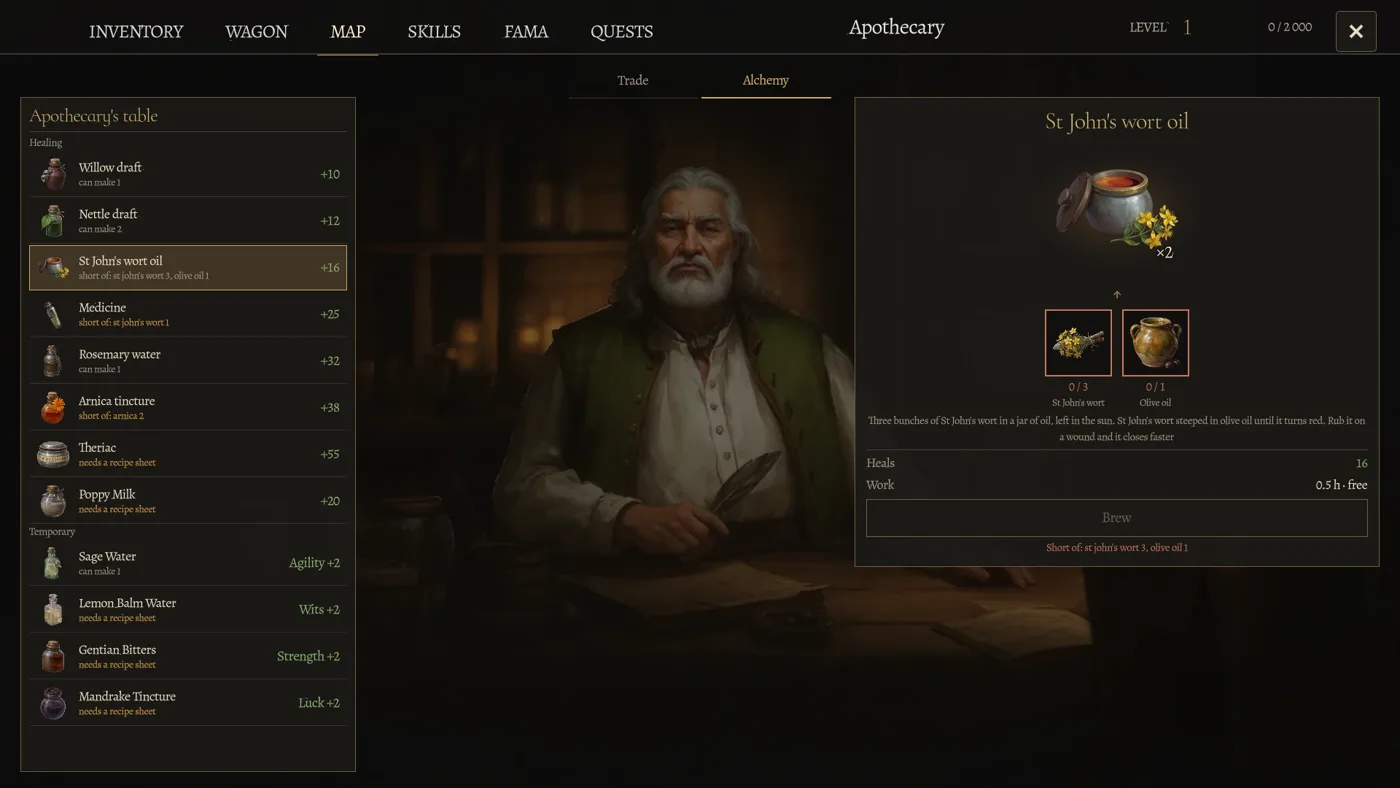
A new group of remedies works for a while instead of healing: sage water for Agility, lemon balm water for Wits, gentian bitters for Strength, and a rare mandrake tincture for Luck.
You can drink them from your belt in a fight or on the road.
New recipes come on recipe sheets, the same way forge blueprints do.
The herbalist's table is split into "Healing" and "Temporary", and each recipe shows what it gives. When you pick a herb, you see when it will grow back.
The apothecary's table in Manresa
The forge shows what you earn
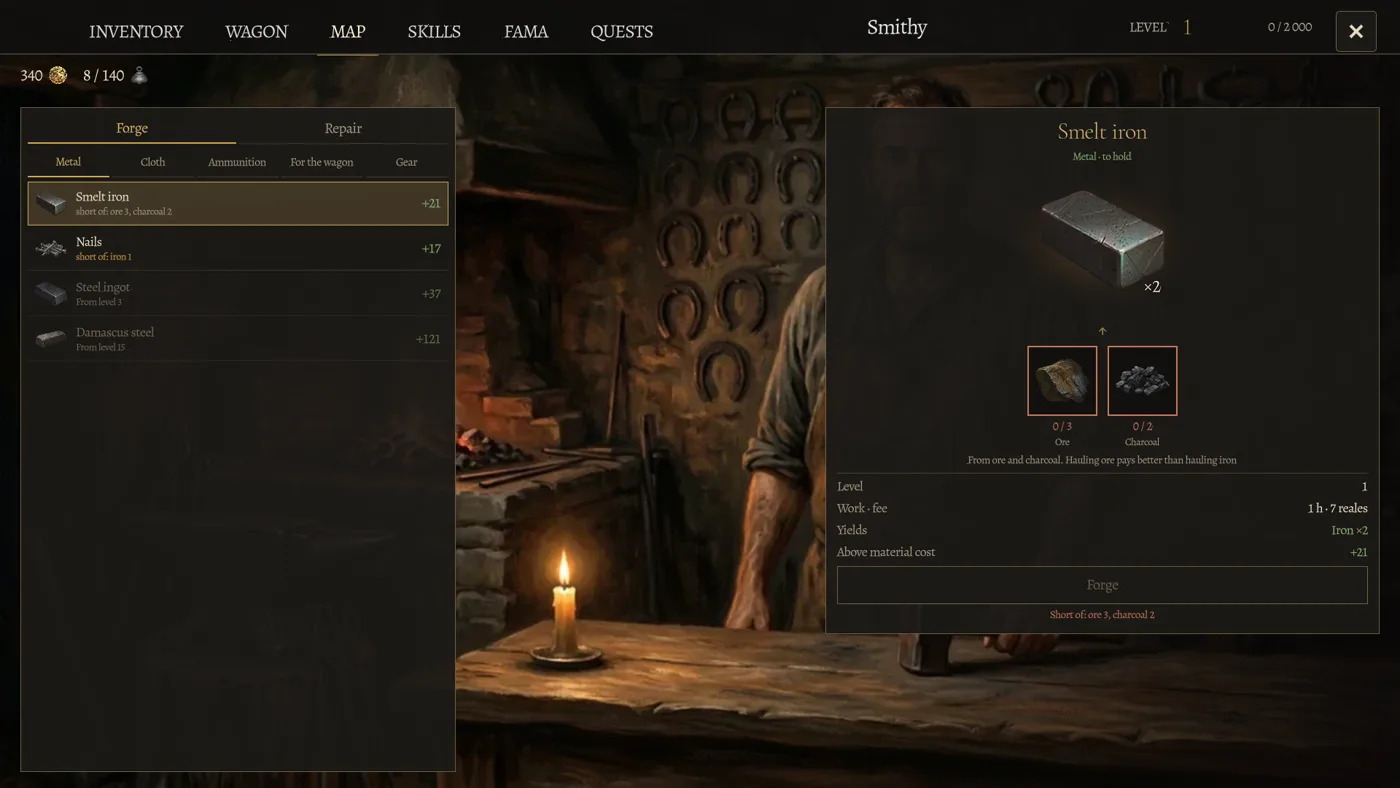
Forge jobs are sorted by level. Next to each one you see your profit after the smith's fee.
A job you cannot do yet shows the price of its blueprint.
The job card tells you if the result comes out cheaper than in a shop, or if the raw materials are worth more than the product.
Forge jobs in Manresa with the profit on the right
One set of prices
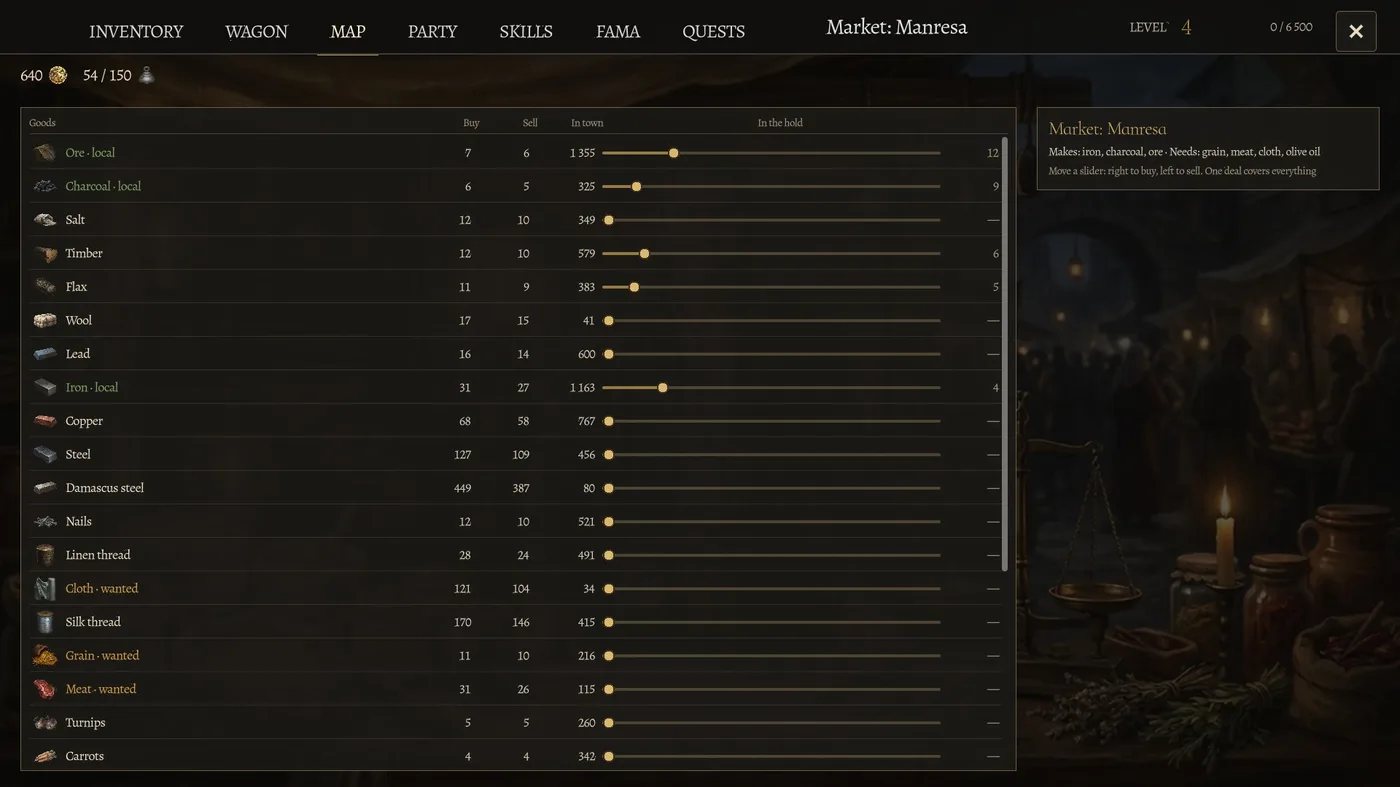
Every trader works by the same rule: the merchant takes a quarter on both buying and selling.
A town's own goods are 30% cheaper there, and goods a town is short of sell for 45% more.
You start with 200 reales.
Market rumors are vaguer now. Some are out of date, and some lead nowhere.
Gathering with tools
To dig ore and coal, pull turnips or cut deadwood, you put the right tool in your weapon slot. The tool wears out as you work, and you can see it in your hands.
Gathering happens right on the field, with a progress bar.
Also
Exits from a place are now marked with filled patches on the ground, like in Fallout.
The sea on the world map: turquoise over the shallows, deep blue farther out, ripples and foam along the coast.
The small map of a place turns with the camera, shows roofs and streets, and can be dragged and zoomed.
A full proofreading pass over the Russian and English texts of the demo and the interface.
A bandit camp on the road replaces a random encounter.
On a phone, the combat bar is easier to use: extra actions fold under "More", and the place map opens with a button.
Next
Polishing the demo and bringing the wiki up to date with the new remedies and prices.
Today was about the road and the pack. The world map now follows the real land, the market got the goods Catalonia actually traded, and the herbalist teaches you to make remedies you can use in a fight.
A map drawn from the real land
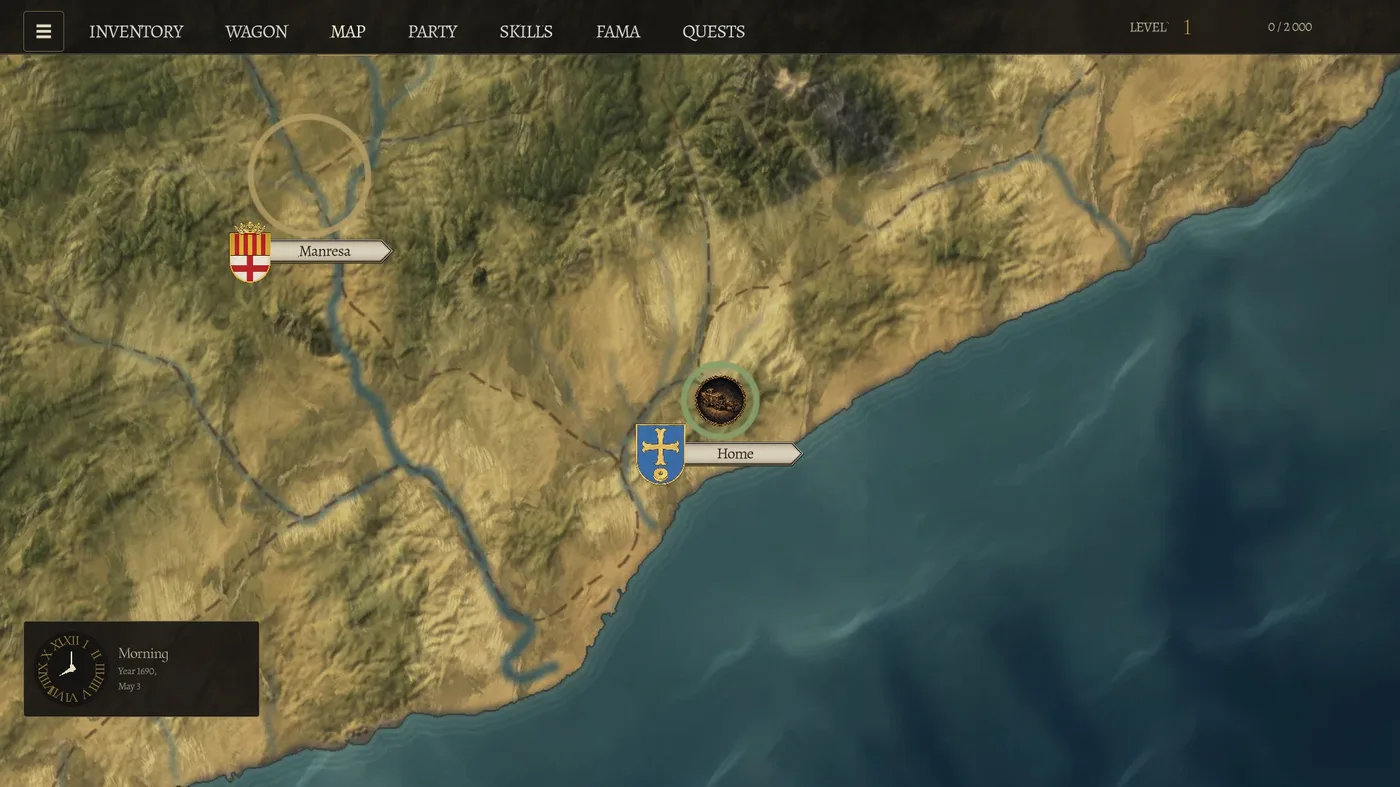
The world map is rebuilt from real terrain: hills, river valleys and the old roads between towns. Towns sit where they stand today, and your wagon now goes around the mountains instead of straight over them, so the road you pick matters.
The new world map, from the home village to Manresa
What Catalonia traded
New goods with real homes: wine from Tarragona and the Empordà, olive oil from Lleida, wool from Puigcerdà, lead from the mines of the Priorat.
Towns now ask for these goods where they really were short, so a good run between two towns is worth finding.
At the forge, every weapon and piece of armor takes charcoal, and bullets, shot and cartridges are cast from lead.
The market in Manresa
Herbs and remedies
Four herbs to pick: rosemary, thyme and yarrow, plus arnica, which grows only in the mountains.
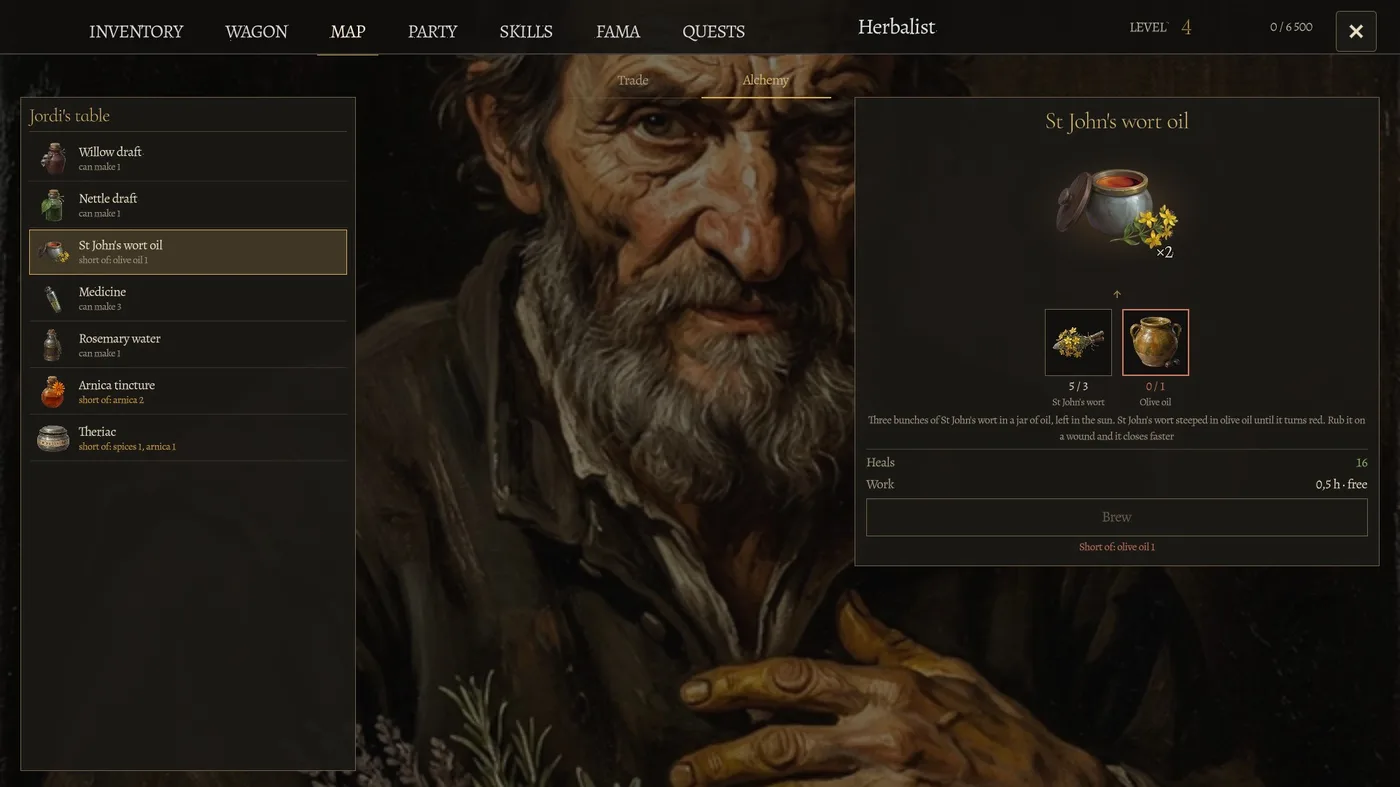
Seven recipes, from a simple willow draft to theriac. Every one of them heals, and you can use it from your belt in the middle of a fight.
Some recipes need what you carry anyway: St John's wort oil is made with olive oil, tinctures with wine from your flask.
Herbs grow in the ravine by the home village and at the edges of town gardens. Each bush gives one bunch and does not grow back, so pick with care.
Herbs now stack in your pack instead of taking a slot each.
In the home village the herbalist lets you use his pot, and a new tutorial step shows you how.
Brewing at the herbalist's table
Also
A new walk: arms swing, the body moves with the legs, and the hero no longer slides when he starts walking.
The demo for Steam Next Fest in February 2027 is taking shape. In it you travel with Iggy only, and fights on the road are sized for the two of you.
Next
Bringing the wiki up to date with the new goods, herbs and remedies.
Yesterday was about buildings. The important houses in every town now have real floor plans you can walk into, and we went through all 23 town districts to fix what made the streets look fake.
Walk into the big buildings
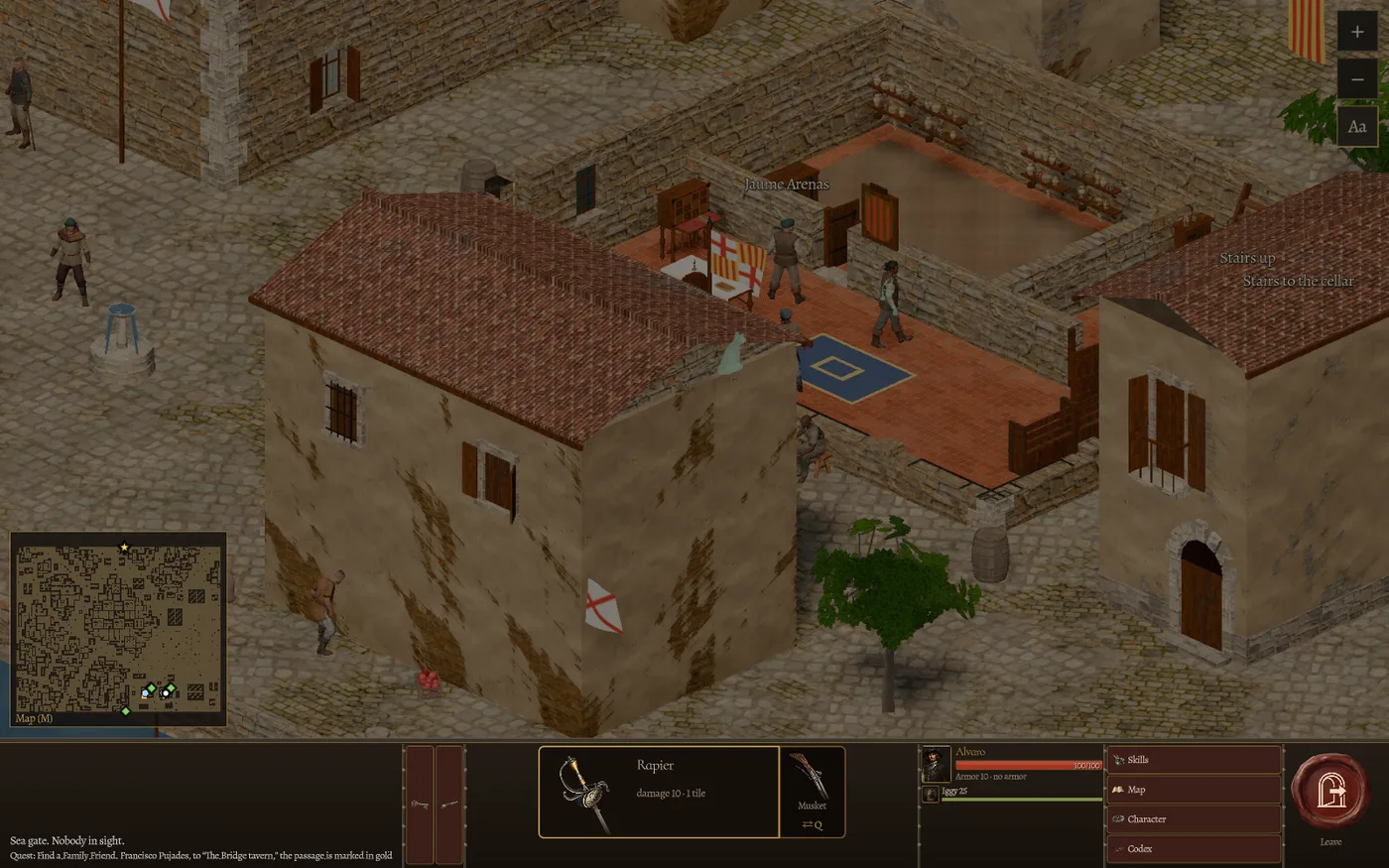
Until now most buildings were closed boxes. Now the ones that matter have their own plan with rooms, furniture and people inside:
In Barcelona, the Palau de la Generalitat and the Llotja, the exchange where merchants trade by the harbor.
Churches and cathedrals in Manresa, Barcelona and Girona: a nave with pews facing the altar, a sacristy, and stairs down to the crypt. Outside they keep their bell towers and banners.
The chapel of Sant Jaume, the houses from side stories, the hospitals and the foundry.
The local trades of the smaller towns: an ore yard, a charcoal store, wool and salt.
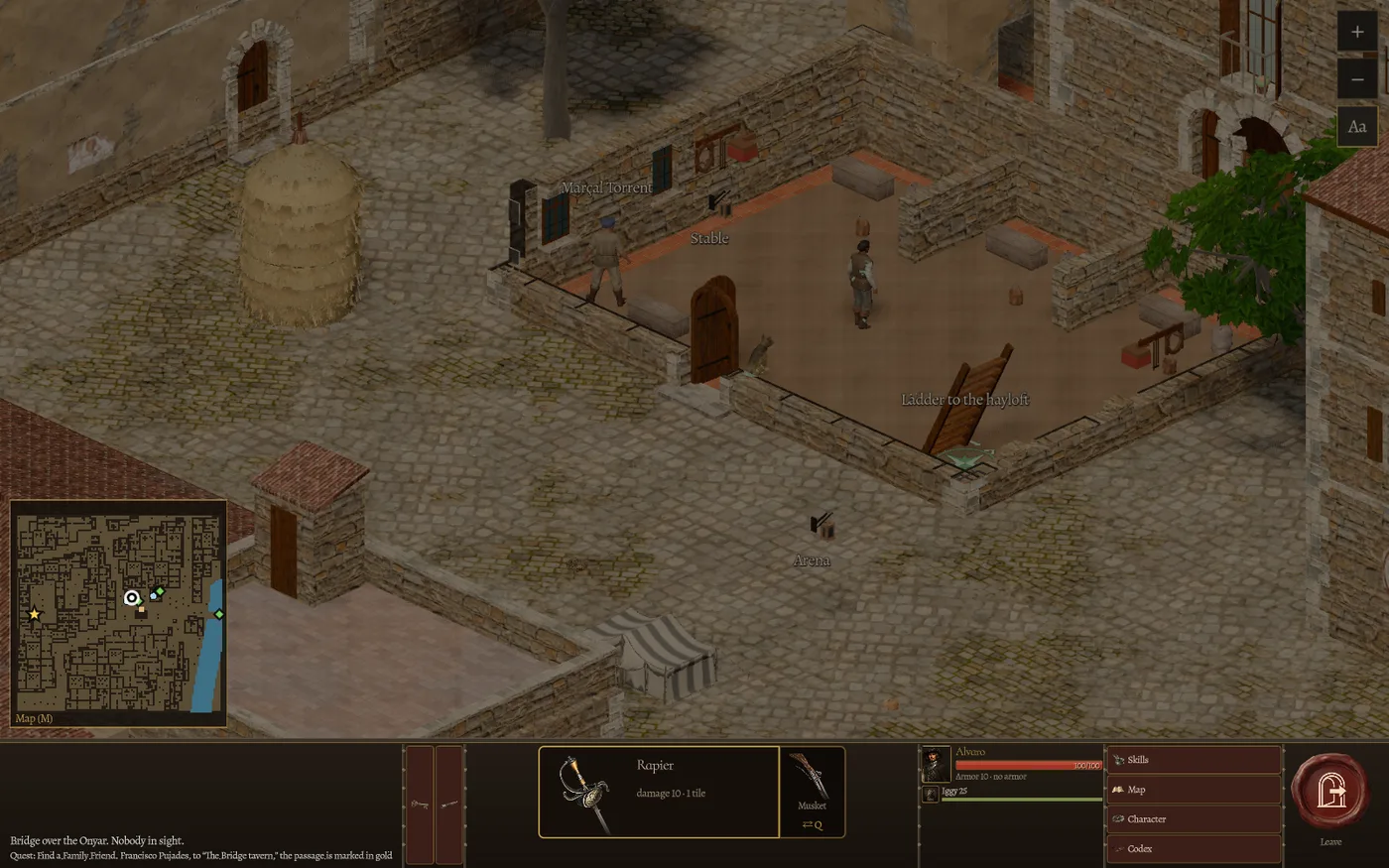
Stables with stalls, harness on the walls, a ladder to the hayloft, and a groom you can talk to.
Inside the Llotja in BarcelonaA stable in Girona, by the bridge over the Onyar
Streets that look lived in
We walked every district of every town and fixed what looked wrong.
Floor tiles no longer stick out from under the walls onto the street.
Plaster walls have texture now, and in places the plaster has fallen off to show the stone underneath.
Empty lots became vegetable gardens behind low walls, or small squares with orange and almond trees.
Solid blocks of houses got inner courtyards.
Small houses got a purpose instead of an extra floor: a chapel with a bell on the gable, a storehouse, a barber, a bakery, a workshop, a cooper.
Cross-shaped corners on roofs and walls are gone.
A walled vegetable garden in Manresa
Also
Doors open with a click, and only locked doors need a key. Doors between rooms inside a house are always open. When you look at a locked door, it tells you which house the key is in.
Fewer hidden stashes per district, so searching houses feels less like a chore.
Rivers and the sea have waves and a proper shore.
Shops, the market and the forge share one deal card, and every list shows prices. At the market one slider per good sets how much you want in the wagon.
At the apothecary's table you can brew salves and herbal remedies from herbs you picked yourself.
Next
More people on the streets, and more houses on the main streets with plans of their own.
Yesterday was about the people you talk to and what you hear. Every townsperson got a new face, the weapon panel was rebuilt, and the game got more music and sound.
Faces from 17th century paintings
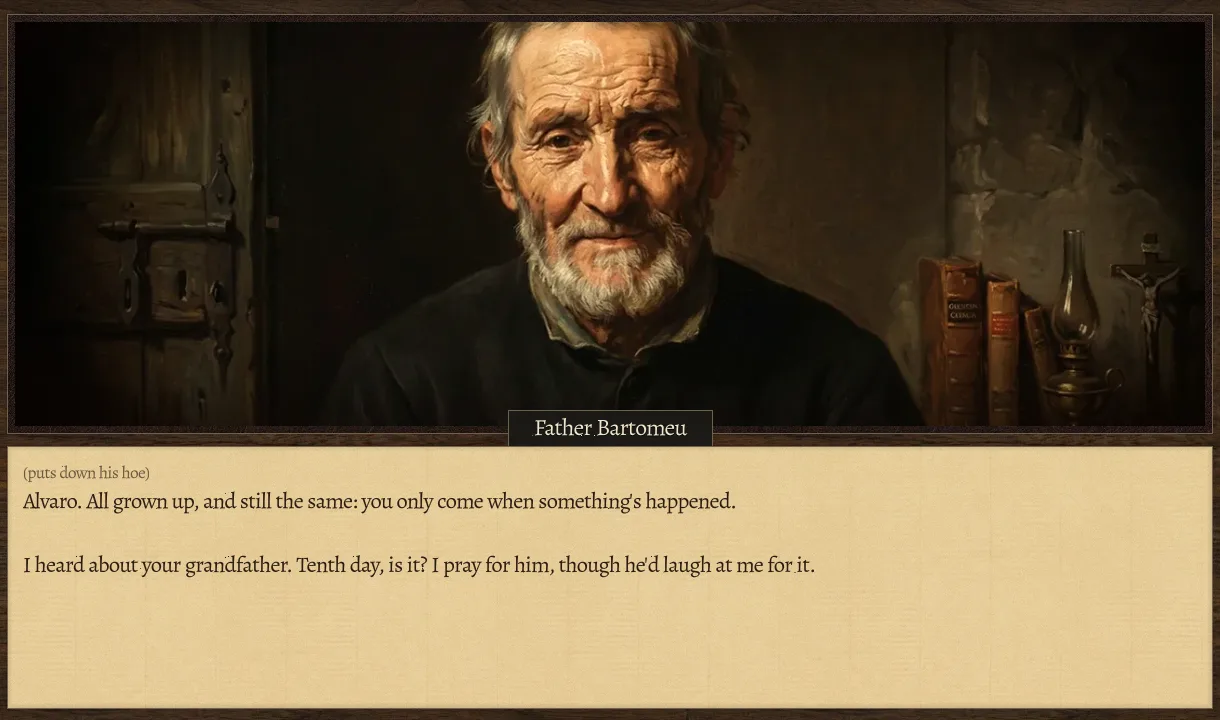
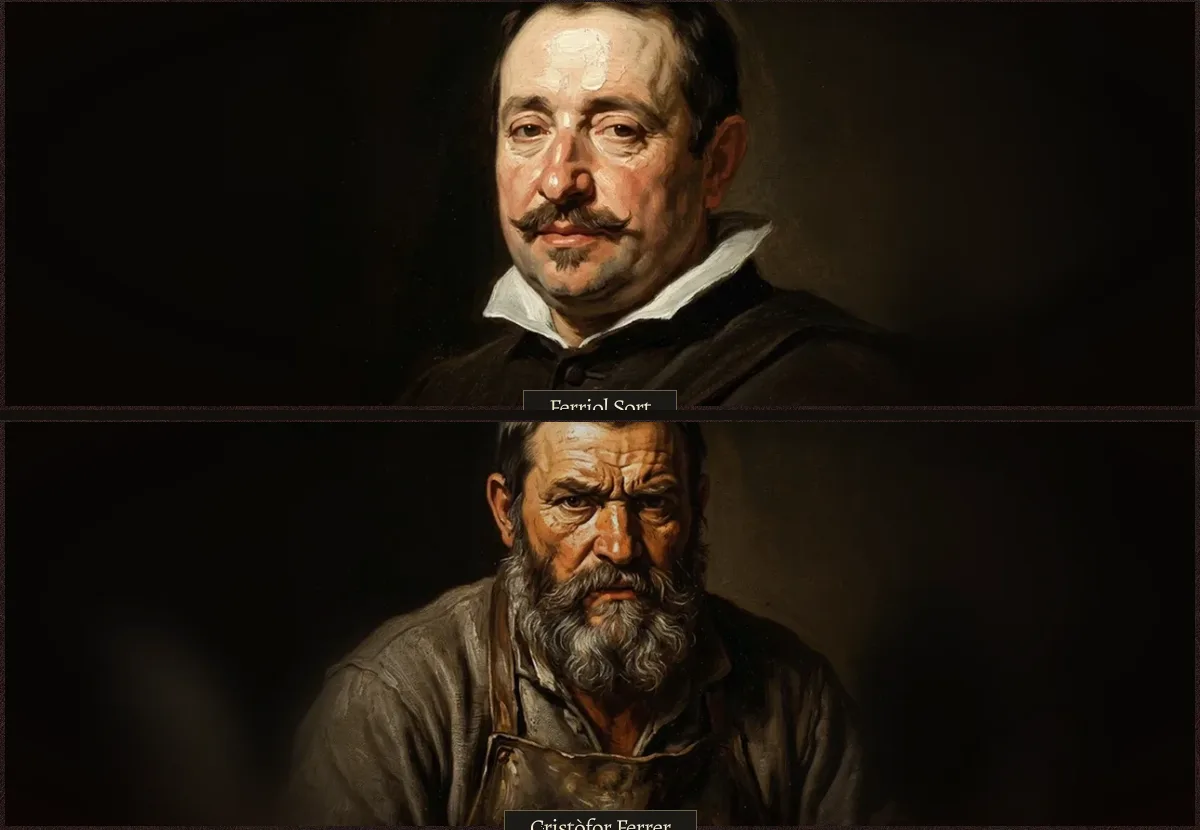
The portraits in the talk window were drawn from scratch before. Now each one starts from a head in a real painting of the period: Velázquez, Ribera, Murillo, Zurbarán, Le Nain, La Tour, Caravaggio. All of them are in the public domain. We collected 177 heads from 78 canvases and matched each of the 89 townspeople in ten towns to a head of the right age and look, so no two people share a face.
Father Bartomeu, the village priestA cloth merchant in Manresa and a butcher in Vic
The opening scenes about the fire were redrawn the same way, with one face for each hero across all scenes.
The weapon panel
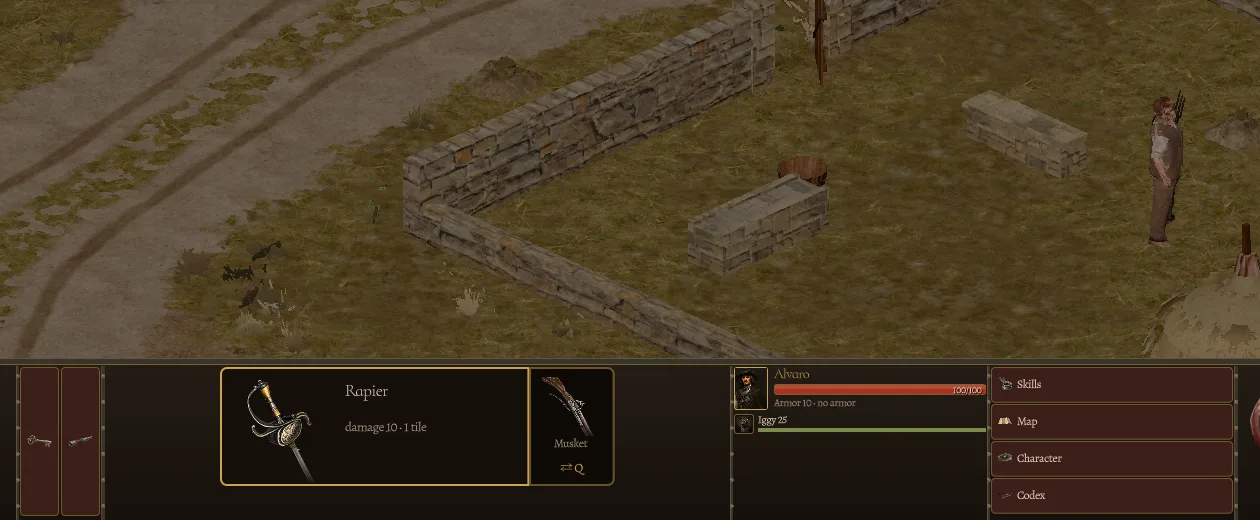
The weapon in your hand is now one large card with its icon, name, damage and wear. Tap the card to strike the nearest enemy or reload an empty gun. The second weapon sits beside it like a sheath: tap it or press Q to take it in hand. The row of ten dots that showed when you could strike again looked like action points, and the game has none: fights run in real time with pause. In its place there is an hourglass with the seconds left. Your party is listed with faces and health bars.
The new bottom panel
Music and sound
More music, all from tracks we had already bought: Bach in the main menu and in fights, choirs in the church and on the screen you see when you die, Scarlatti in Girona and Barcelona, and a choir with a Bach sonata at the end of the demo. Fights in town districts no longer play the peaceful music of the place. Buttons click, quests ring when a step is done, and hooves sound while the wagon crosses the world map.
On the phone
The web build went from 293 MB to 217 MB, and the world map no longer goes blank on iPhone.
The 3D field draws at half resolution on phones, without sun shadows.
In conversations on a phone the face sits on top and the answers stay at the bottom of the screen.
The clock on the world map and the road encounter window are easier to read.
Also
Road encounters build their field from the same generator as other places, and you can only flee back the way you came.
New stance and walk for Alvaro and the townspeople, taken from bought animation packs.
Next
Better movement: Alvaro starting to run, Iggy running at a full gallop, and people turning on their feet to face you.
Yesterday was about towns feeling lived in: street names you can learn, notice boards, coats of arms, people on the squares, and rooms furnished the way Catalan homes were in 1690.
Streets and notice boards
Houses had no numbers in 1690 and streets had no name plates. People knew a street by the saint in a small niche on the corner house and by the trade worked on it. Each street now has such a niche. When you look at a niche or a house, the map remembers it, and you can see every street and house you have noted.
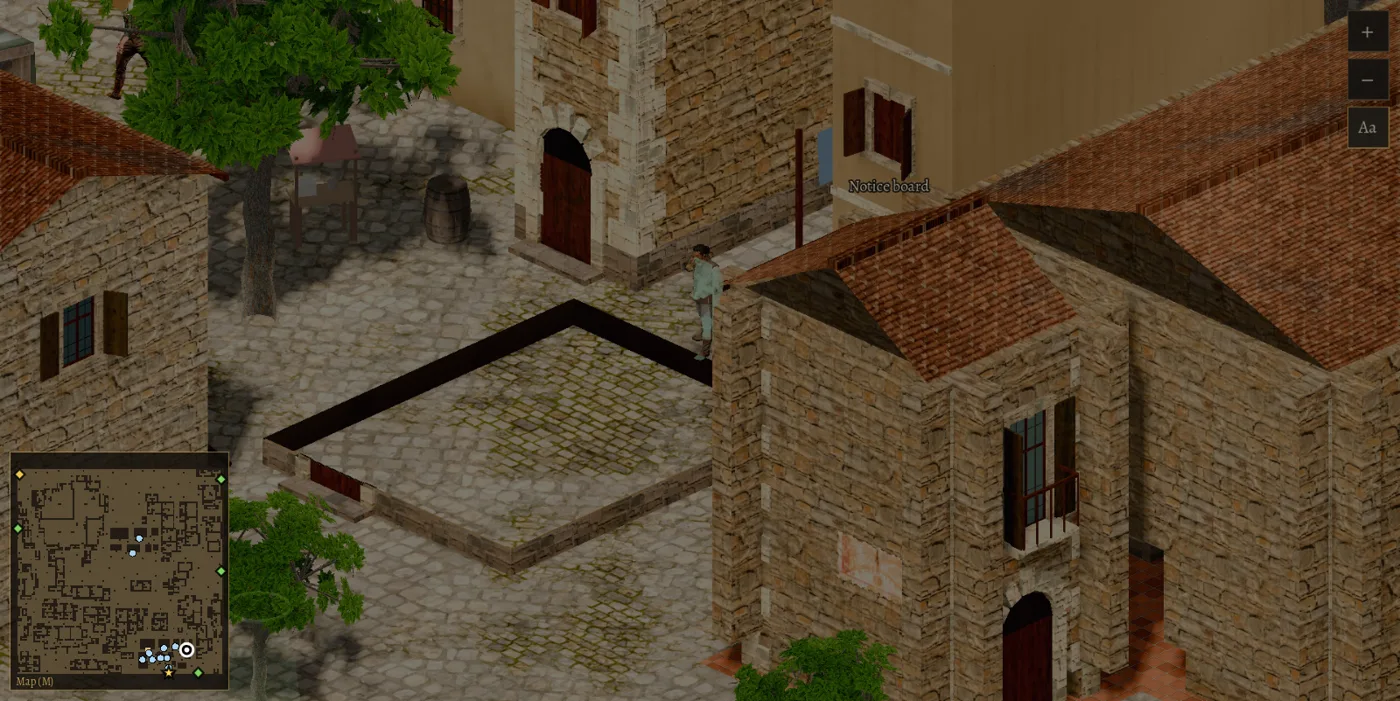
The main squares of Manresa, Vic, Girona and Barcelona got notice boards. The sheets change from day to day: news, advice, odd requests, and leads that start the town's stories.
Coats of arms
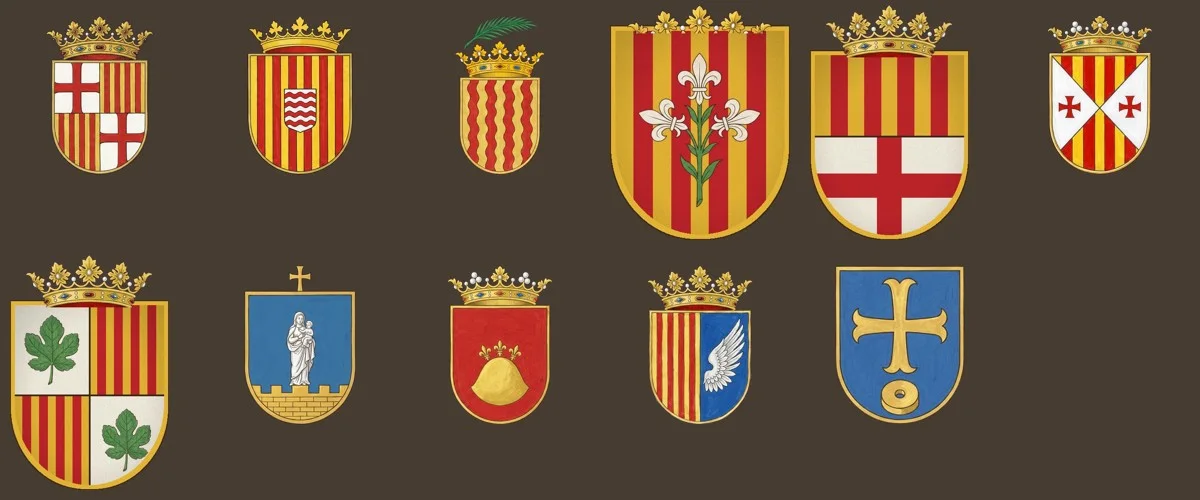
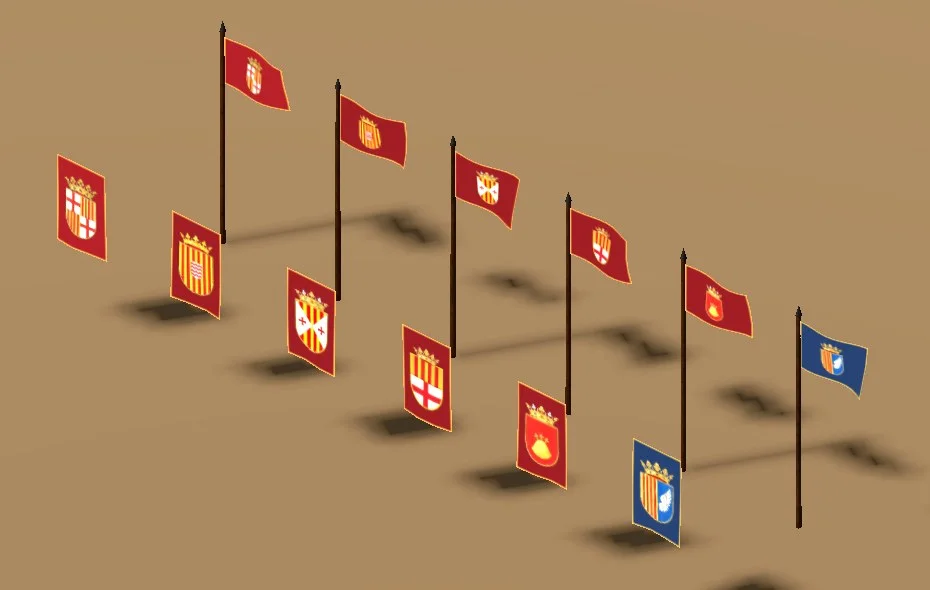
Every town now has its own arms, drawn from its historical blazon as it looked around 1690, with the rounded Spanish shield of the period. They mark the towns on the world map and fly on banners by the notice boards and town halls. The port of Barcelona now flies the city's own banners.
The arms of the towns of CataloniaTown banners
People on the squares
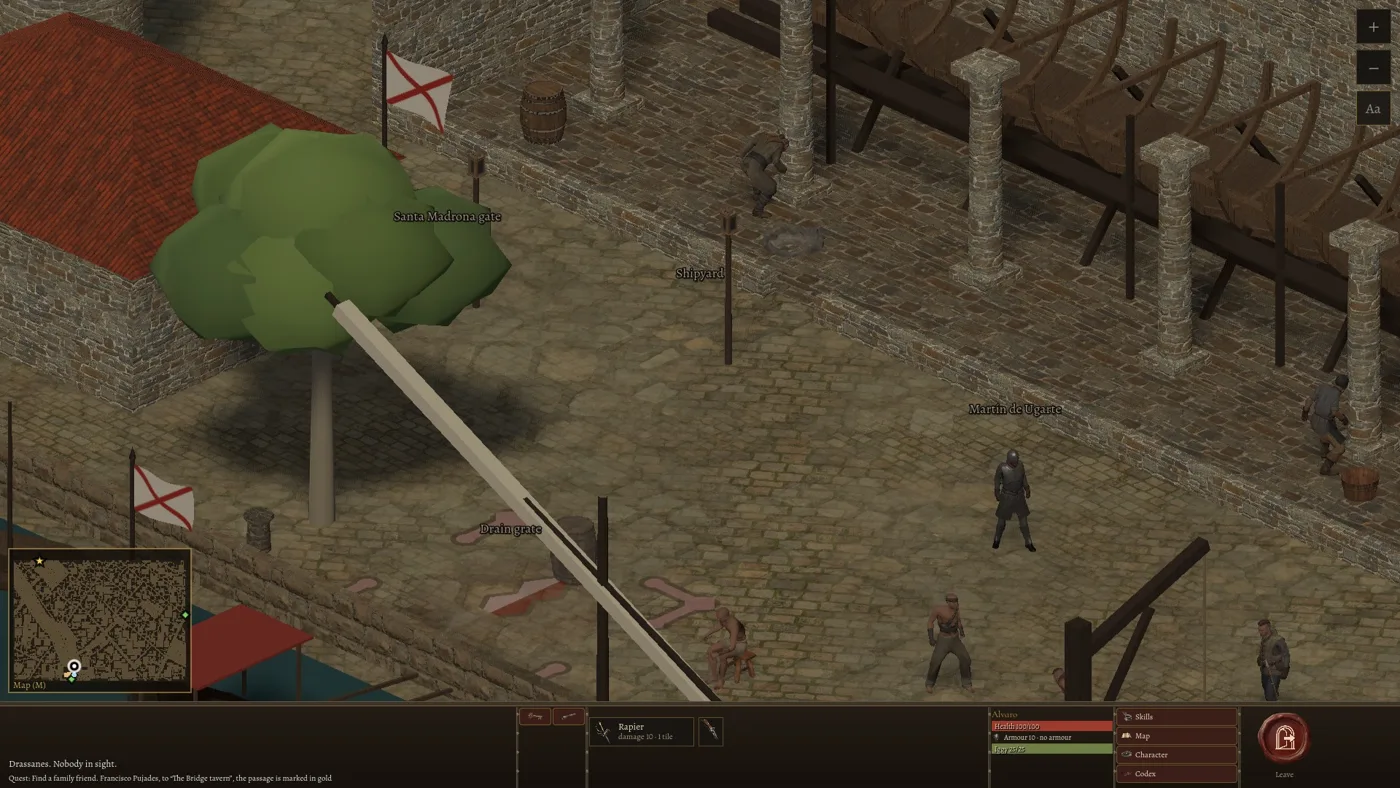
Squares and streets have passers-by who walk, stop and walk on. In the port of Barcelona half of them are porters carrying sacks between the quay and the warehouses.
Furniture of the period
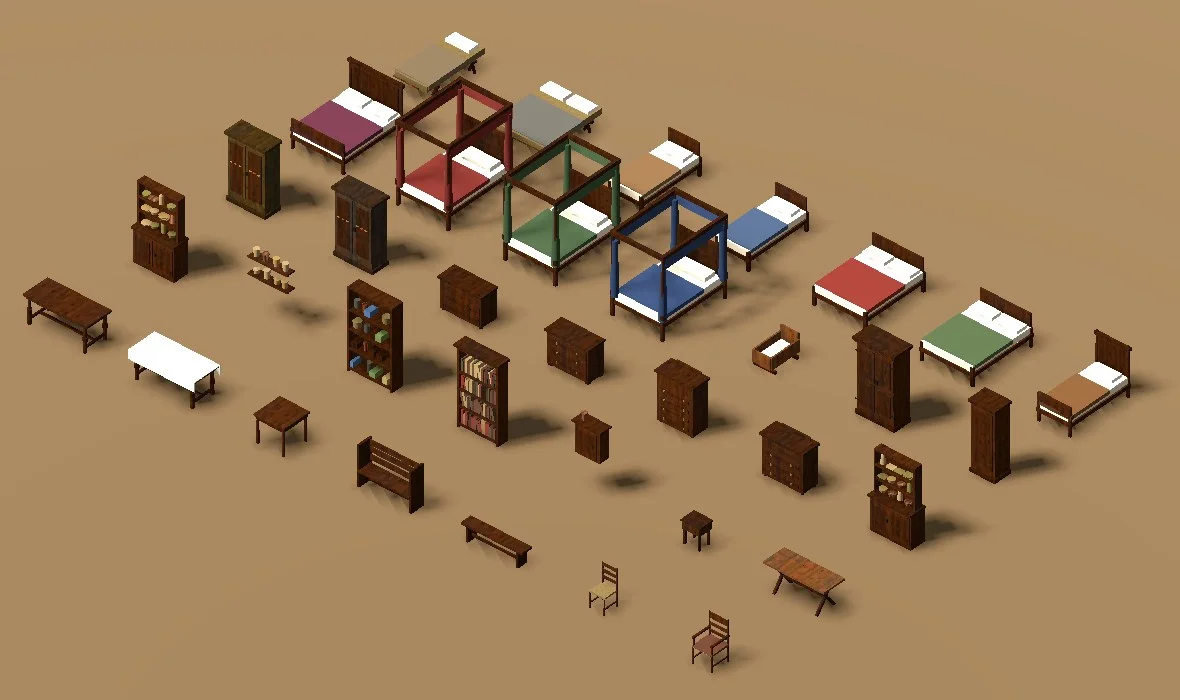
The rooms no longer look like they hold modern shelving. There is now a catalog of furniture made for the period: poor and rich beds, single and double, four-posters with curtains, wardrobes, chests of drawers, tables, benches and shelves. Every piece has a price and a weight, ready for buying and selling furniture and, later, furnishing a house of your own.
Part of the furniture catalog
Churches, pits and mines
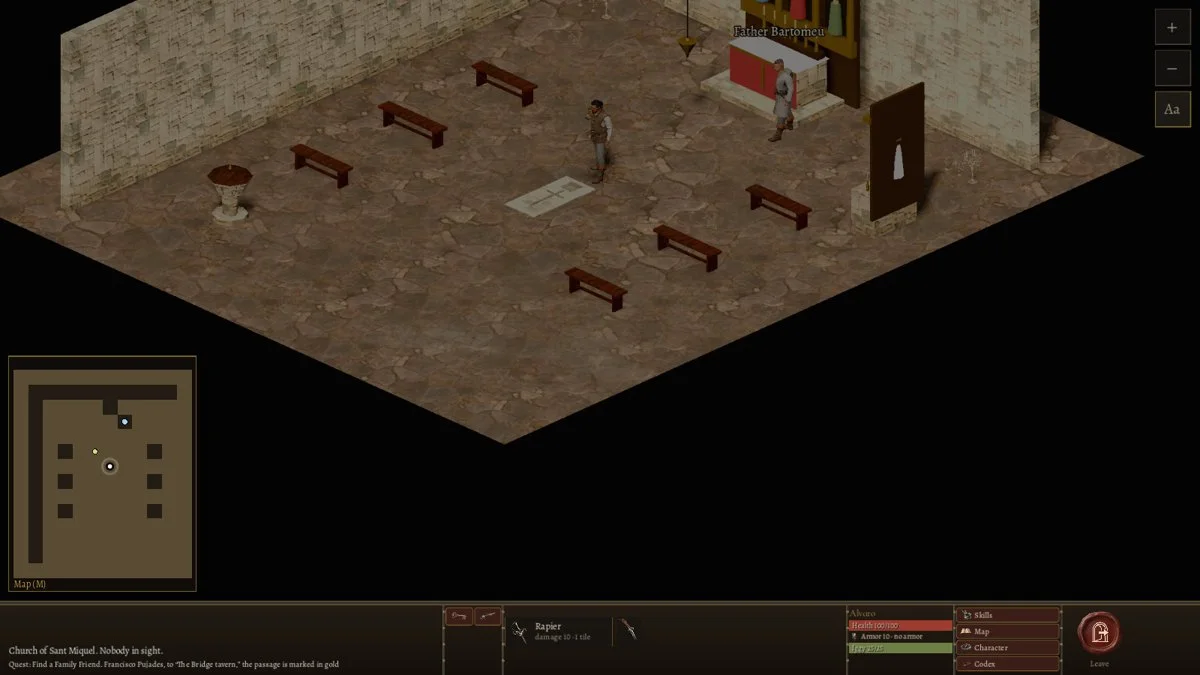
Churches got altarpieces, side altars, pulpits, fonts, confessionals and tomb slabs. The charcoal pits of Manresa are now earthen funnels instead of wooden boxes. Mines and cellars got rock walls, props and lamps, and the workers swing their picks and axes with the sharp end forward.
The village church of Sant Miquel
Also
Barcelona and six smaller towns (Figueres, Olot, Puigcerdà, Lleida, Tarragona, La Seu) now use their real plans at full scale.
Floors depend on the room: square tiles in kitchens, herringbone in the master's rooms, beaten earth in pantries, rugs and esparto mats in bedrooms.
Next
Portraits for everyone you talk to, painted after real Spanish paintings of the 17th century.
Yesterday Girona joined Manresa and Vic at real scale, and we went back over how the town blocks are cut into houses.
Houses, not slivers
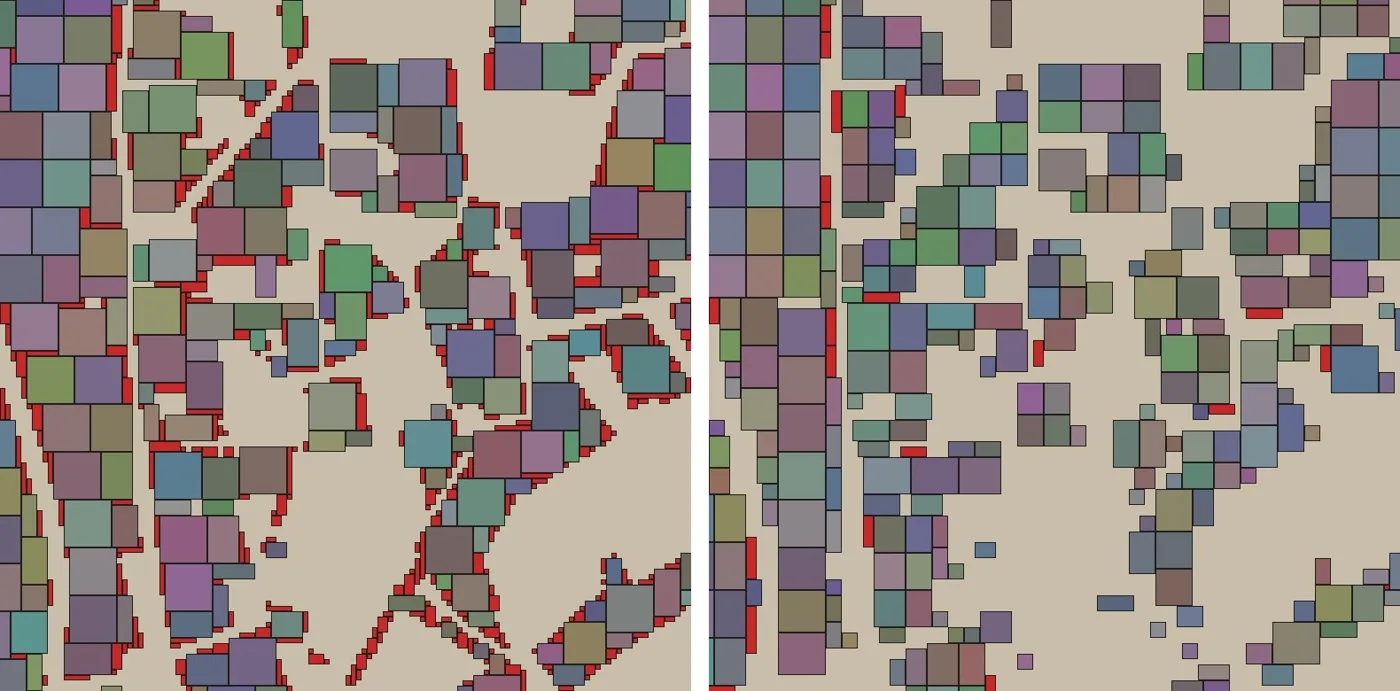
The old towns come from today's street maps. A city block on those maps is one big shape, and the game cuts it into separate houses. The old cutter took the biggest piece it could and left the rest as strips one or two tiles wide. Seven houses out of ten were strips like that, and they showed: blank walls, gaps at street level, odd stubs between real houses.
The new cutter splits each block into proper rectangles first and then divides them evenly, so a block eleven tiles deep becomes two houses of six and five instead of nine and a sliver of two. Small leftover teeth along diagonal streets became paving. Girona went from 3,770 thin houses to 154.
The town plan before and after. Red marks the houses thinner than three tiles
Girona at real scale
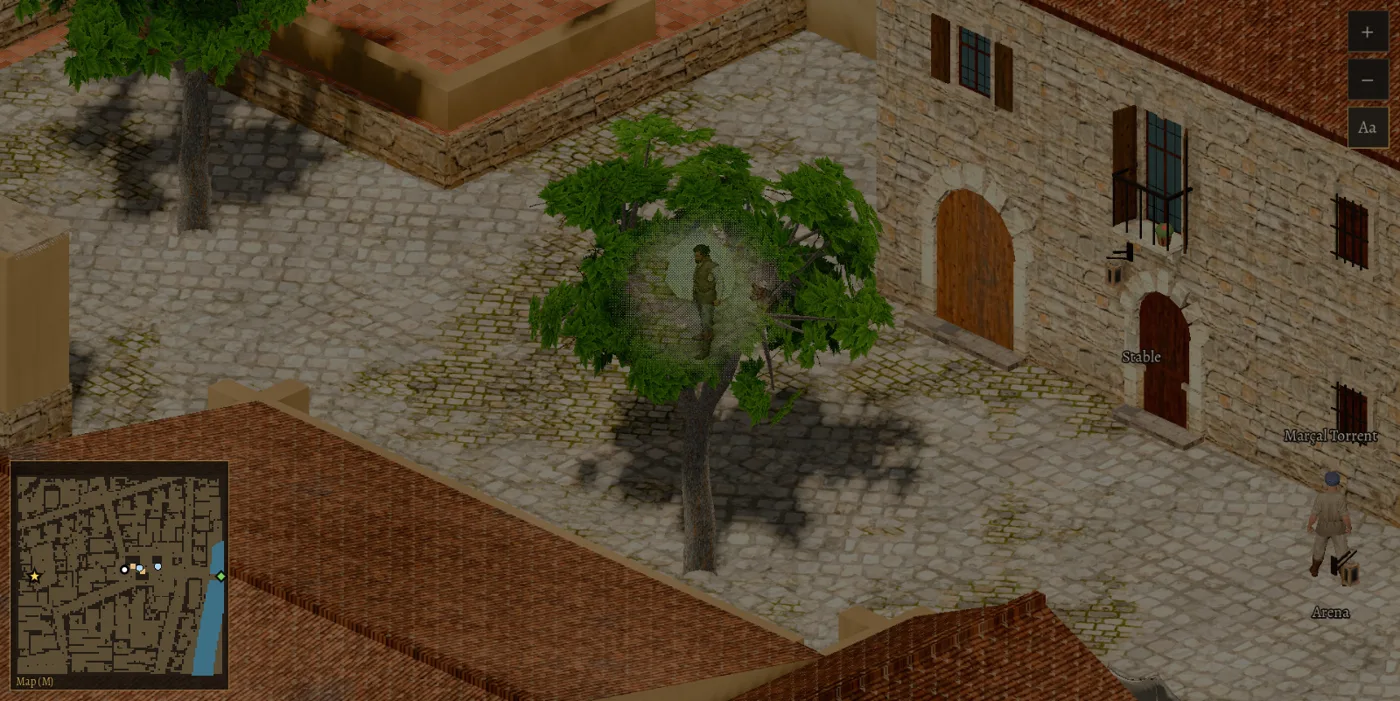
All three districts of Girona now use the real plan at 1.4 meters per tile, with the bridge over the Onyar where it was.
The old town of Girona near the cathedral
You stay in sight
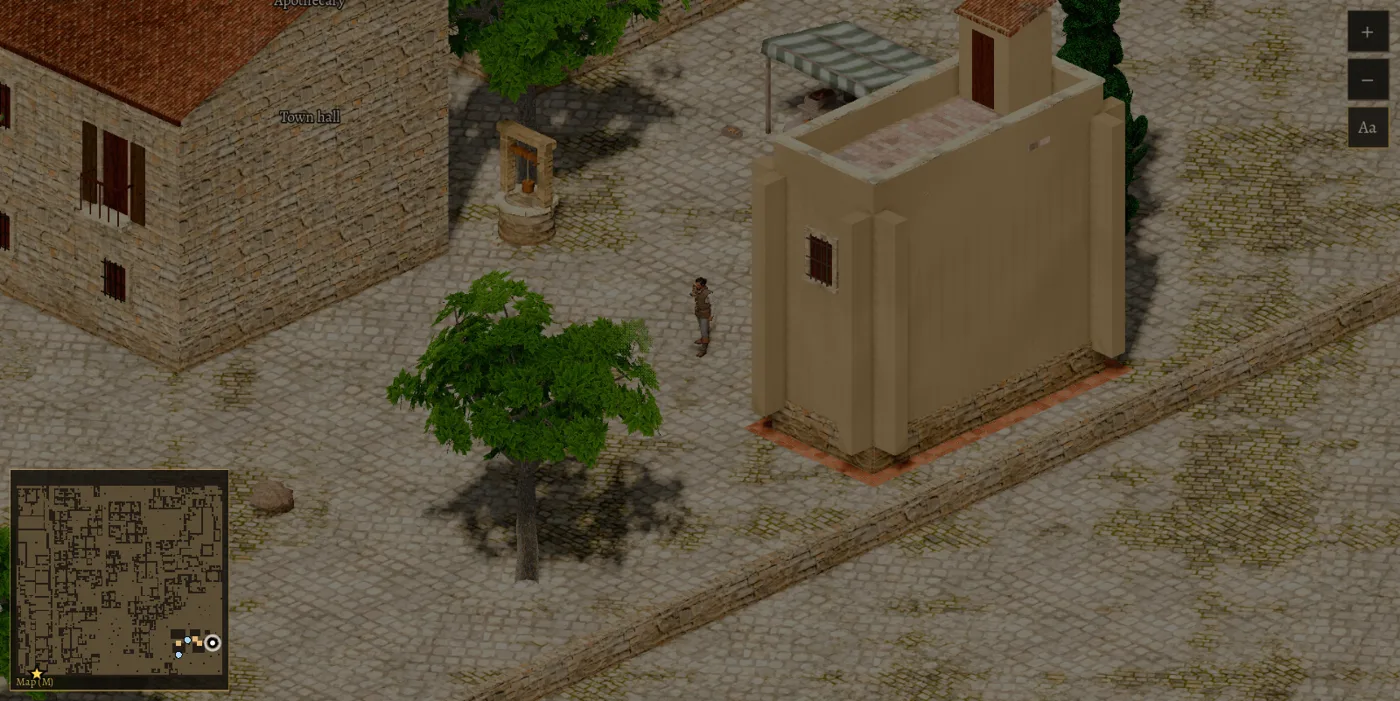
When a house stands between the camera and Alvaro, it now gets out of the way instead of leaving him as a silhouette behind a wall.
Manresa: a house that would hide the hero is cut down to its foundations
Also
The web build is about 20 MB lighter.
Classical pieces for battles, churches and dungeons are encoded smaller with no audible loss.
Next
Street names, house numbers you can note on the map, and notice boards in every town square.
Four days of work went into one thing: how the world looks up close. Trees, stones, grass, the ground, and above all the towns, which now match the real streets of 1690 at their real size.
Real scale
Our town maps come from today's street plans of the old centers, and the old cores of Manresa, Vic and Girona still keep their 17th-century layout. Until now the plans were squeezed by a third, and the narrowest lanes were a single tile wide. Now one tile is 1.4 meters, the same as on the battlefield. Streets got wider, squares got bigger, and every district keeps its old size in tiles.
Girona, the square by the stable in the Onyar quarter
Catalan houses
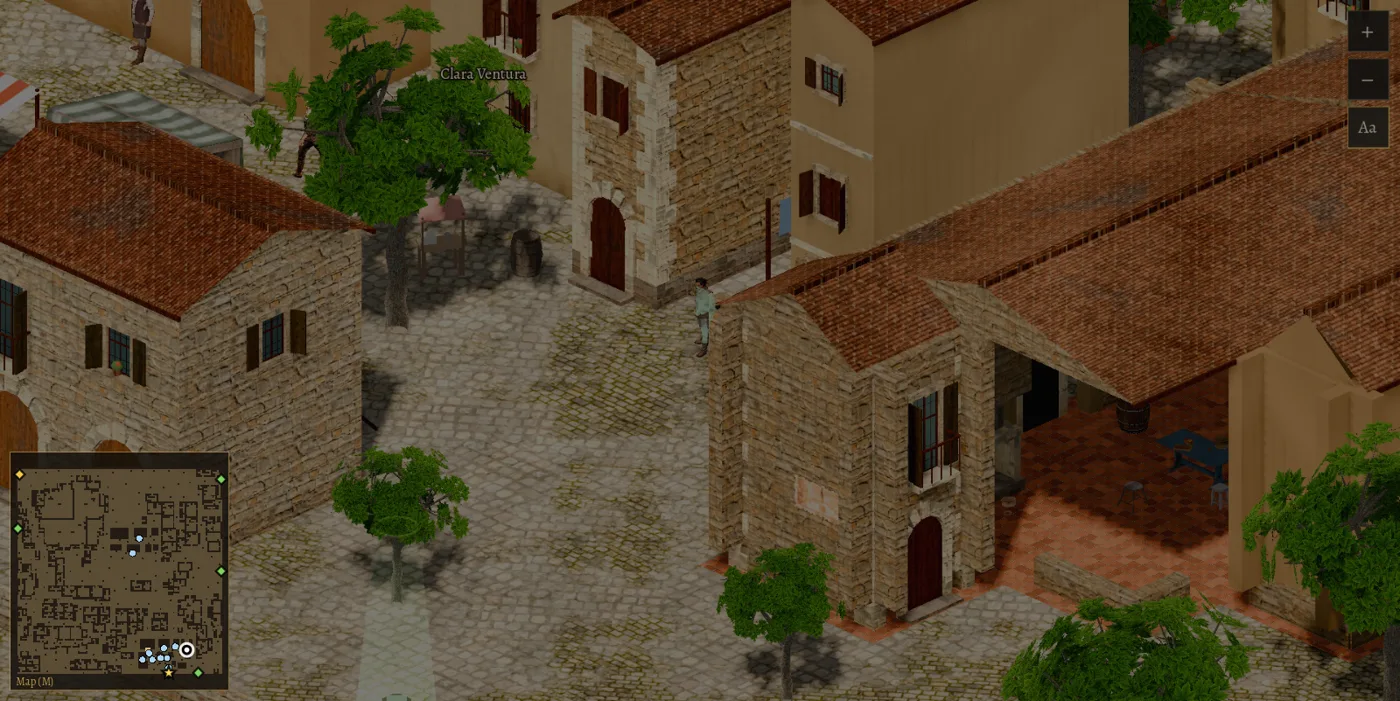
The quarters used to be roofless rooms. Now they're whole houses, built the way Catalan towns built in the 1690s:
floors of the right height, two or three stories, sometimes a flat roof terrace with a little stair hut;
clay tile roofs in faded brown, and the gable faces the street;
not many windows, small ones, with stone frames, wooden shutters and an iron grille on the ground floor;
arched doorways, now and then a balcony with a pot of geraniums.
When a house stands between the camera and your hero, it hides completely, so you never lose sight of Alvaro behind a wall.
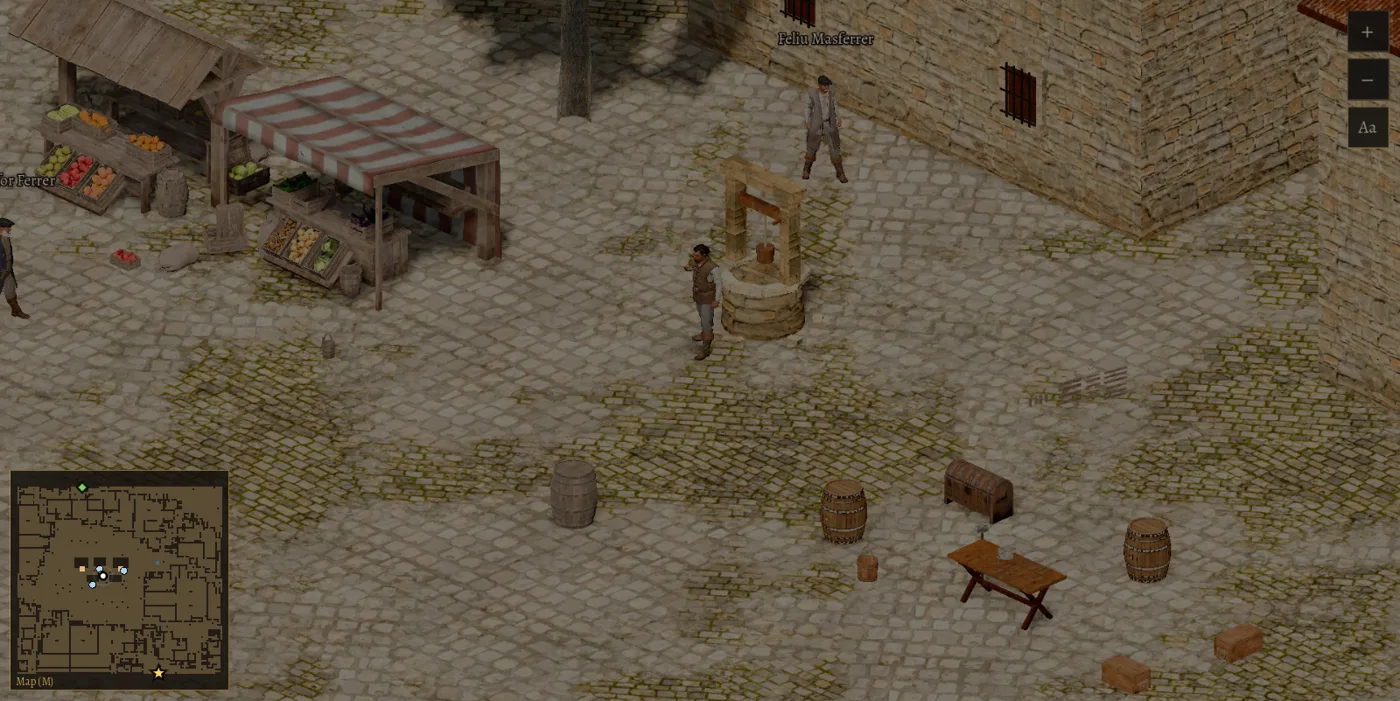
Vic, the market by the well
Ground, grass and stones
The ground and the grass are now photo-scanned surfaces: cobbles, dry earth, trampled paths, dry grass. Trees are drawn by species (plane, olive, cypress, orange), and their crowns thin out when the hero walks under them. Stones lie in groups half sunk in the soil, pebbles collect by the streams, and nothing blocks a path.
Town life
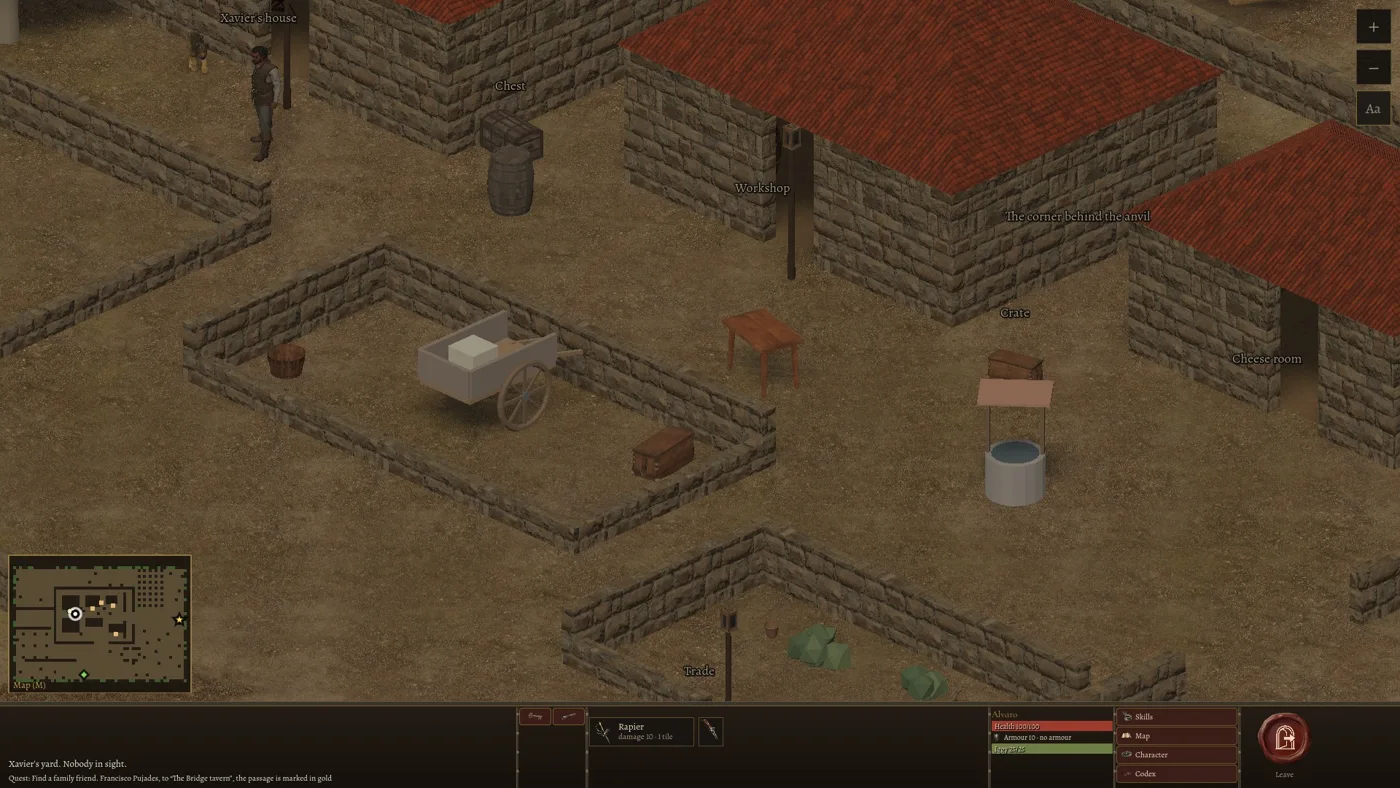
Wells come in four kinds, and each town has its own. Carts, benches, trestle tables, woodpiles and drying sheds now stand outside instead of furniture that belongs indoors. Lanterns hang on iron brackets by the doors. Some blank walls carry painted signs: sundials, saints, guild marks. A few of them are something else, made for players who like to look closely.
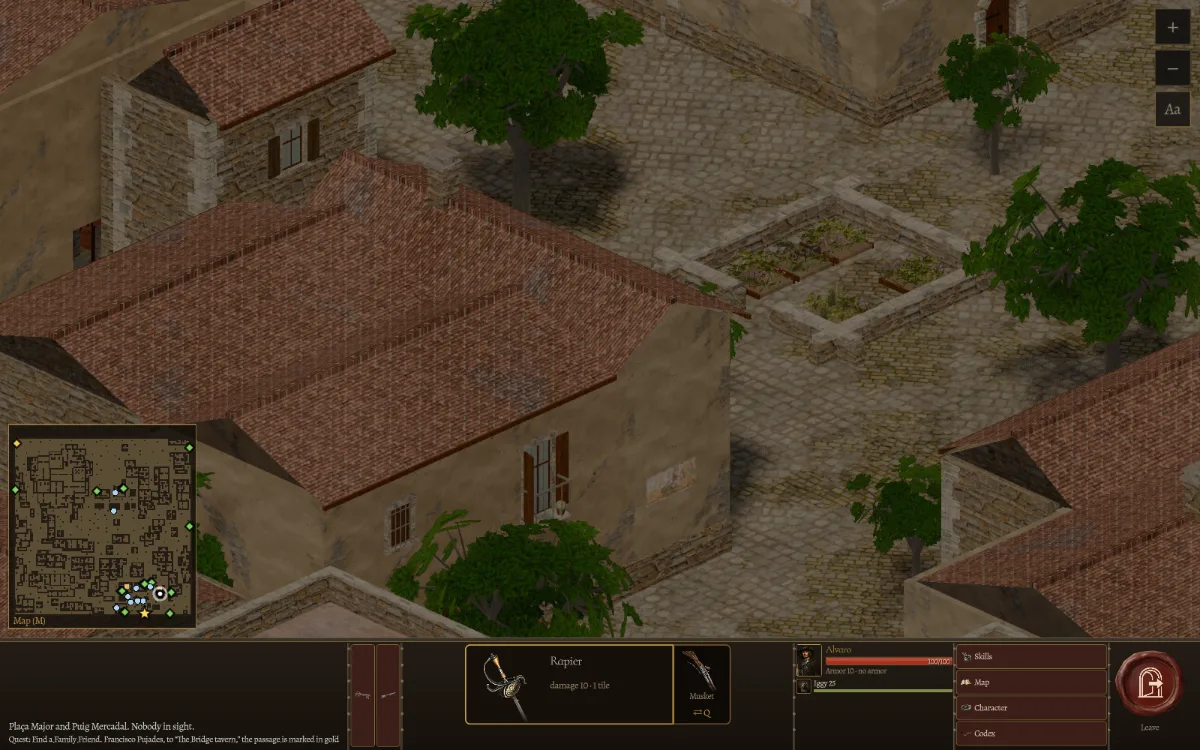
Manresa, the main square
Music
Battles, churches, taverns and dungeons got new music: Vivaldi, Bach, Handel, Scarlatti, Monteverdi, Byrd and Machaut. We only picked composers who lived before or near 1690, or whose music people of the time would have known.
Yesterday was about the people of the home village and the roads around it. The demo now has five side stories, and each of them changes something after it ends.
Five stories with consequences
A side story used to end with a reward and a line in the quest log. Now the world answers back. People greet you differently, a rumor reaches the next town, a road gets more dangerous, and every story has its own card at the end of the game.
Pau's knife. A shepherd boy lost his uncle's knife by the stream where the wolves ran. What you do with the wounded wolf you find there matters more than you'd think.
Cheese for Bernat. Your grandfather promised the innkeeper cheese for the village feast. Some of it has gone moldy. You can be honest, cut the mold off, or sell it to the dealer who offers more. Your reward is a choice too: money now, or a letter that opens doors in Manresa.
The widow and the mule. A widow's only mule turns up in a Manresa stable with a receipt that doesn't add up. You can buy it back, argue, call on the muleteers' brotherhood, or take it by force, and someone will remember each of those.
The convoy at the post. If you've found out where the night carts of charcoal come from, you can join an ambush at an old border post in the mountains.
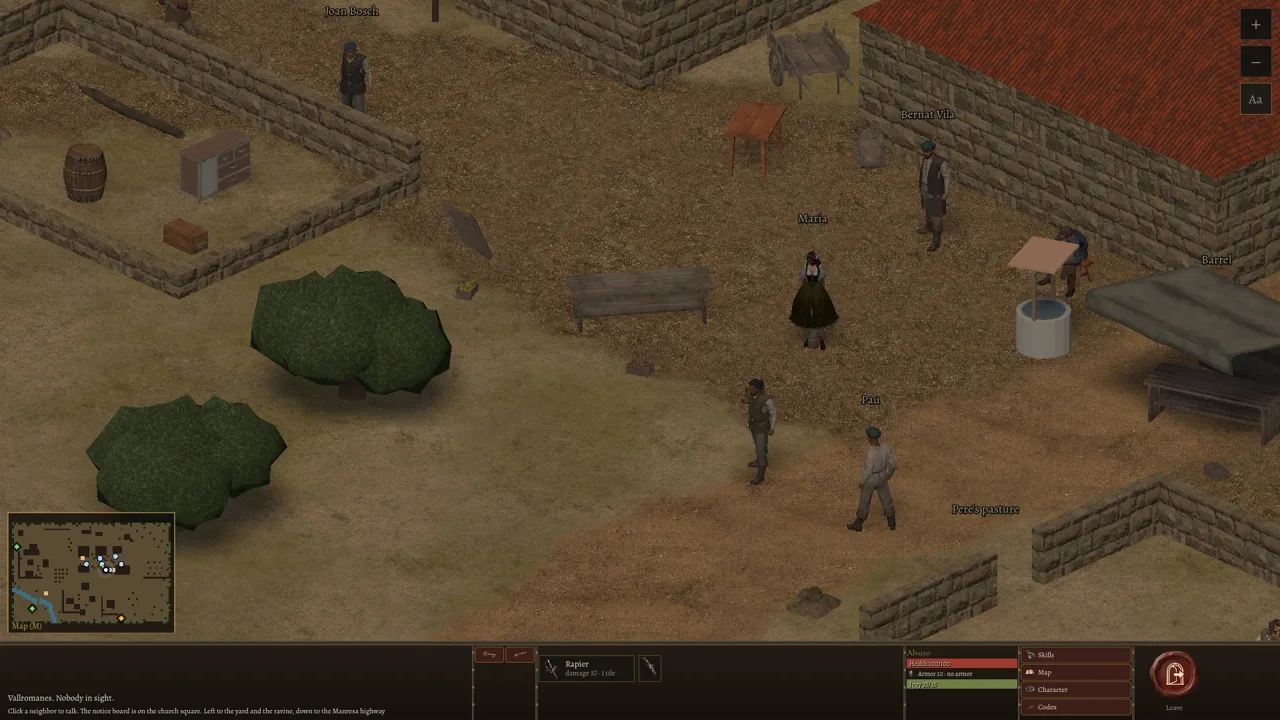
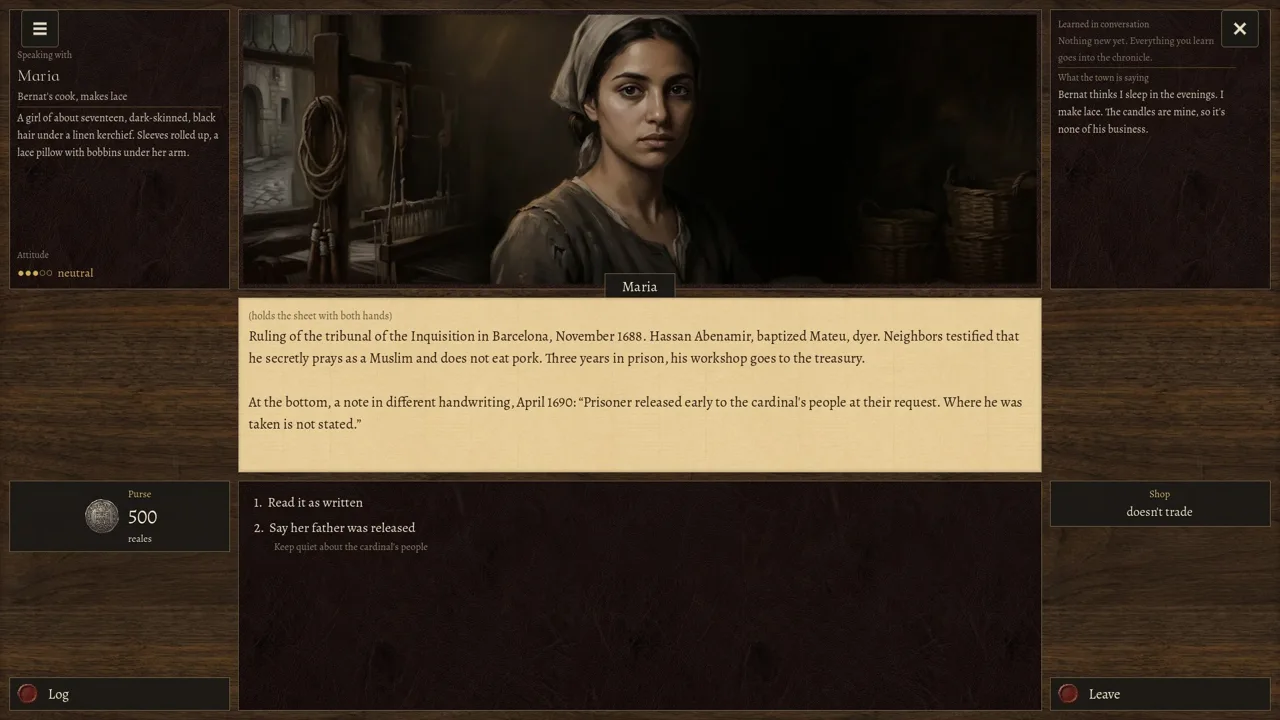
Maria. She works in the inn's kitchen, makes lace in the evenings and saves every coin. Take her lace to the fair in Vic and see what she trusts you with when you come back.
The home village, with Maria by the well
Nothing in these stories tells you how the characters feel about you. You find out from what they do.
Maria asks Alvaro to read a document about her father
Read twice
Every story got two full proofreading passes in Russian and English. We fixed the obvious typos, and also places where two people gave different numbers for the same convoy, a flower bloomed in the wrong month, and a character knew a name nobody had told him.
American English
The English text of the game and this site is now American, both spelling and punctuation: armor, gray, neighbor, and the period goes inside the quotes.
Demo mode and music
The game has a demo mode now. It opens the home village, Manresa and Vic and ends after the first big lead on the grandfather. There is also a Windows build preset for Steam. Home, the towns and the taverns got lute and theorbo music.
Next
Getting the Steam page ready, and a look at loading floors in some interiors.
Yesterday was the biggest day of work so far. Most of it went into the towns.
Towns from real street plans
Every town used to be a menu with dots on a picture. Now every town is a place you walk. We took the street layout of each old town center from OpenStreetMap, cut it into districts, and dressed each district from a painted sketch: squares with plane trees and wells, yards with vegetable beds, barrels at the doors, cobbles.
Manresa has its main square, the Santa Llúcia quarter, the old bridge over the Cardener, the cathedral on the hill and the ore pits across the river, with charcoal kilns smoking next to them.
Vic and Girona have three districts each. Girona has the Onyar river running through it, with a bridge.
Tarragona, Lleida, Figueres, La Seu d'Urgell, Puigcerdà and Olot each have one district with every shop of the town along a street.
Manresa, the old bridge
Barcelona, eight districts and the sea
Barcelona is now eight districts: the Raval, the Rambla, the cathedral, Plaça del Rei, the Ribera, the sea gate, the port and the royal shipyard. The modern seafront was built on land taken from the sea, so we flooded it back. The water comes right up to the houses, as it did in 1690.
The royal shipyard in Barcelona
Home, finished
The grandfather's yard, the house with its rooms and the ravine below the village are rebuilt to the same standard as the village itself.
The farmstead
The game speaks English
English is now the main language of the game. Every line, from the prologue to the shop signs, is translated, and the game picks the language from your browser. There is a switch in the settings.
A pass on phones
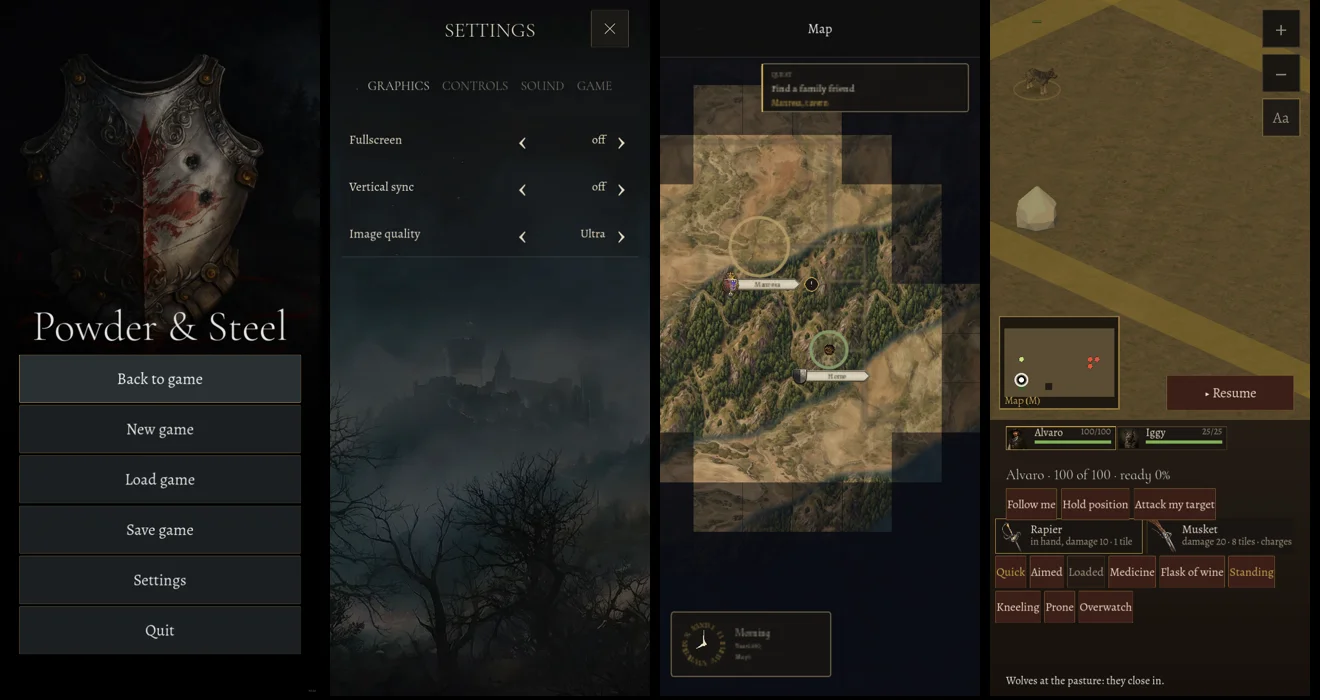
We played the start of the game on an iPhone and fixed what got in the way. The prologue's skip button is now quiet, the name field selects the whole name on tap, the character sheet scrolls properly, and the menu button no longer covers the title. In the first fight the battle now waits until you give your first order. The main menu, the settings, the clock on the world map and the battle bar are all sized for a finger now.
On a phone: menu, settings, world map, battle
Next
Music for home and the tavern, and the next towns on the road to the ship.
This is the first of our daily build reports. Every morning we post what changed in the game the day before, with screenshots straight from the current build.
The game now starts in the right place
A new game opens with the prologue, told in six engravings: the night of the fire, the stranger downstairs, the boy who was reported dead. After it, you no longer land on a map. You land in a fight: wolves are at the neighbor's sheep, and your dog Iggy is holding them alone.
Character creation, Fallout style
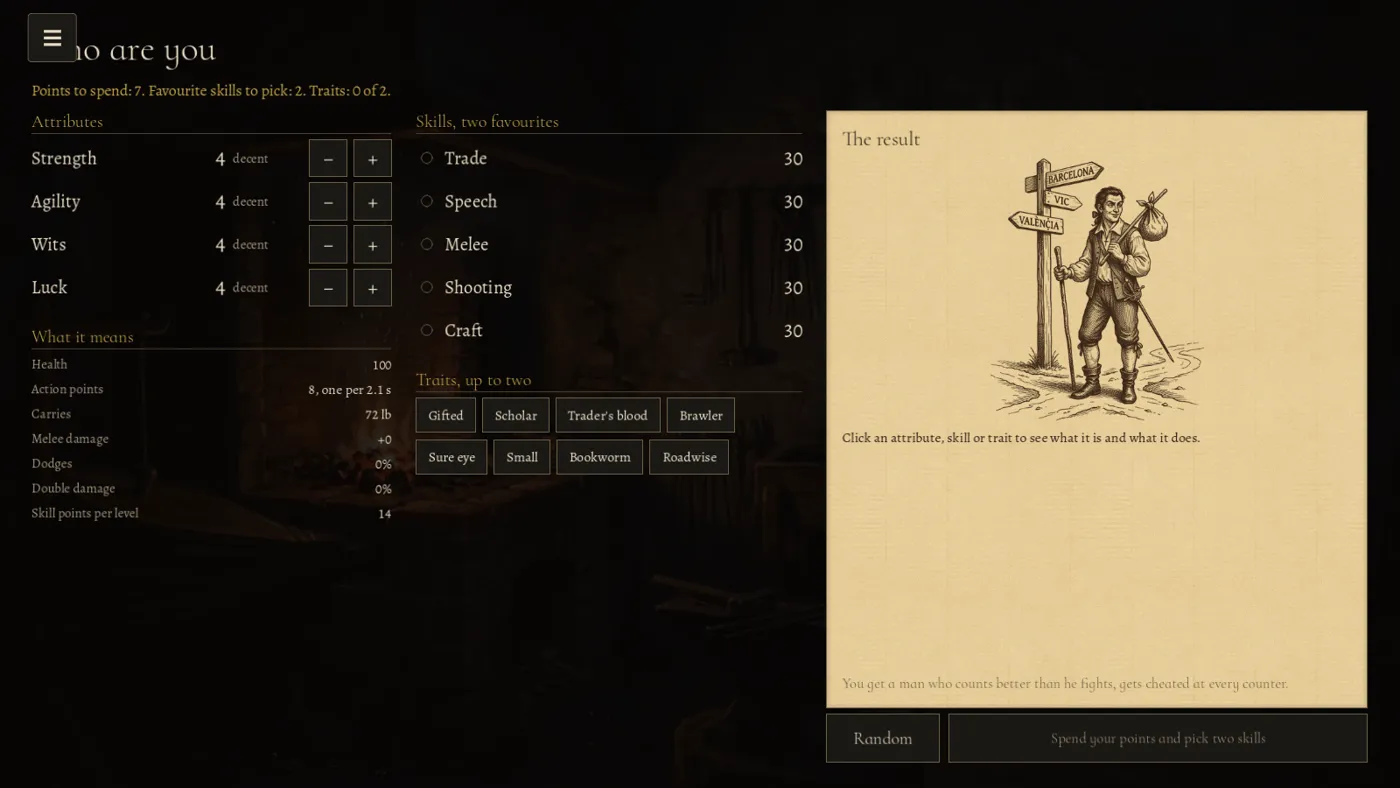
Four attributes, five skills, two favorite skills and two traits, laid out like a Fallout character sheet. Every line has a pen drawing and a plain explanation of what it does. "Random" rolls a whole character, "Back" returns from the face screen without losing anything.
Character creation: attributes, skills and traits
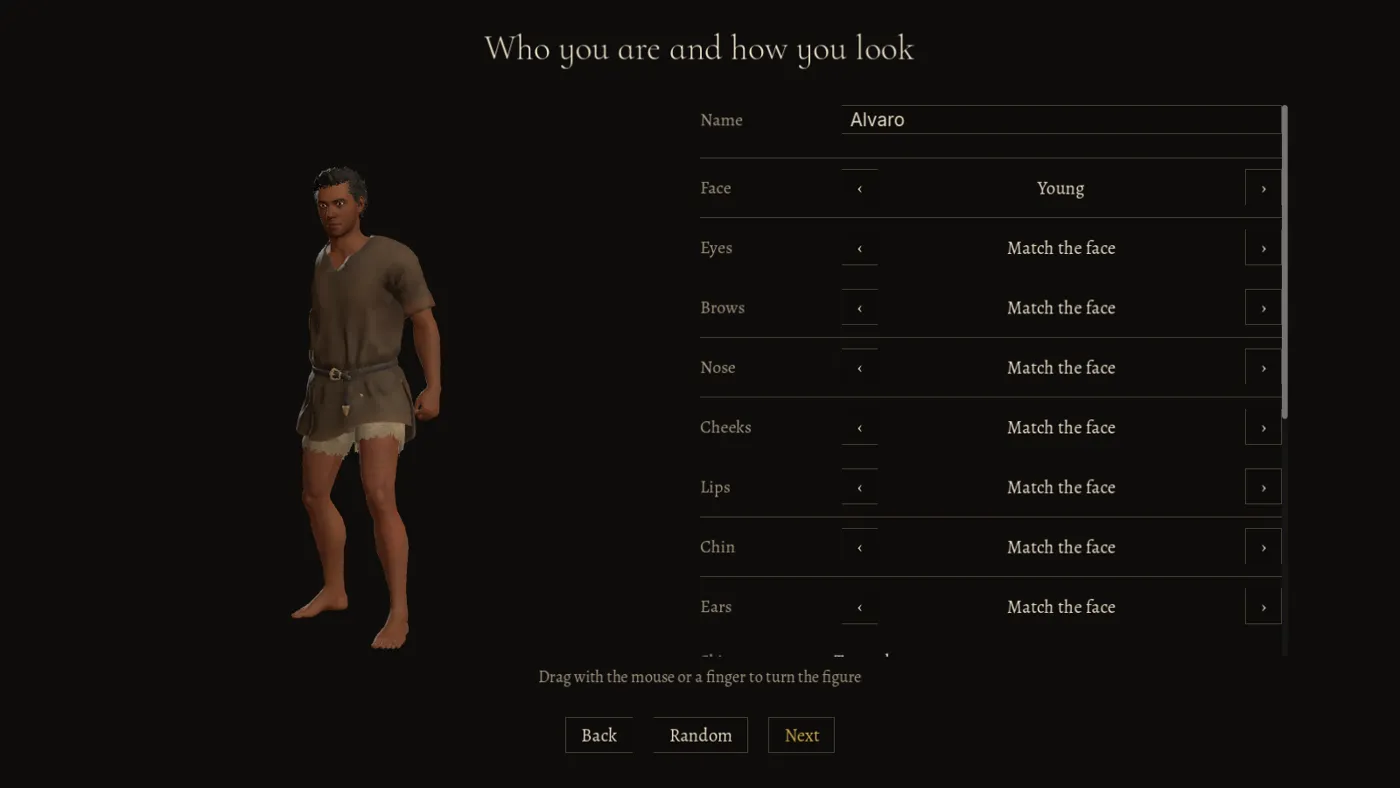
The face screen came next: head shape, eyes, brows, nose, cheeks, lips, chin and ears all move the model, plus hair, beard, skin, height and build. The same screen works as a barber's chair in towns.
The face and appearance screen
Vallromanes, rebuilt from a sketch
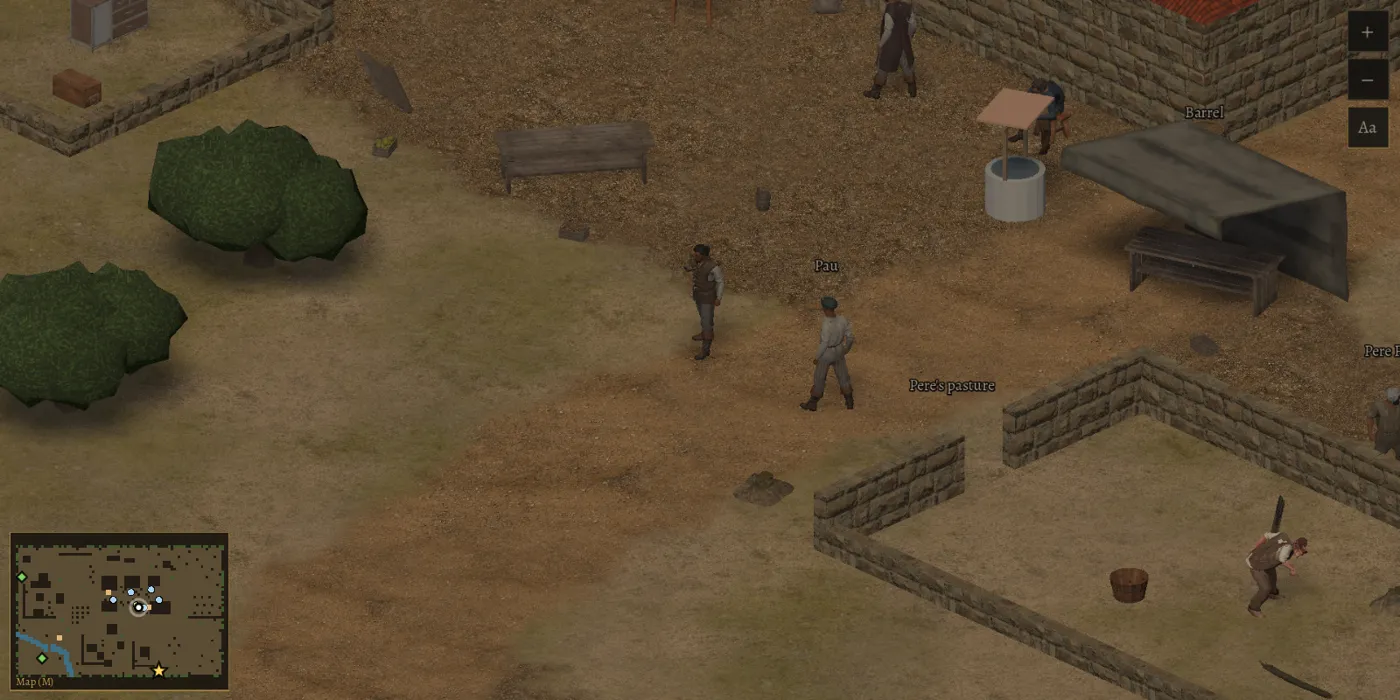
Alvaro's home village used to be a flat field with the same ground everywhere. We drew a plan of it, gave the plan to an image model to paint as a proper village, then rebuilt the level by that painting: farmhouses, stone walls, fields, olive groves and a stream at the edge. Houses now have roofs like in Fallout 2, and the roof lifts when you walk in.
Vallromanes in the game
A map of every place
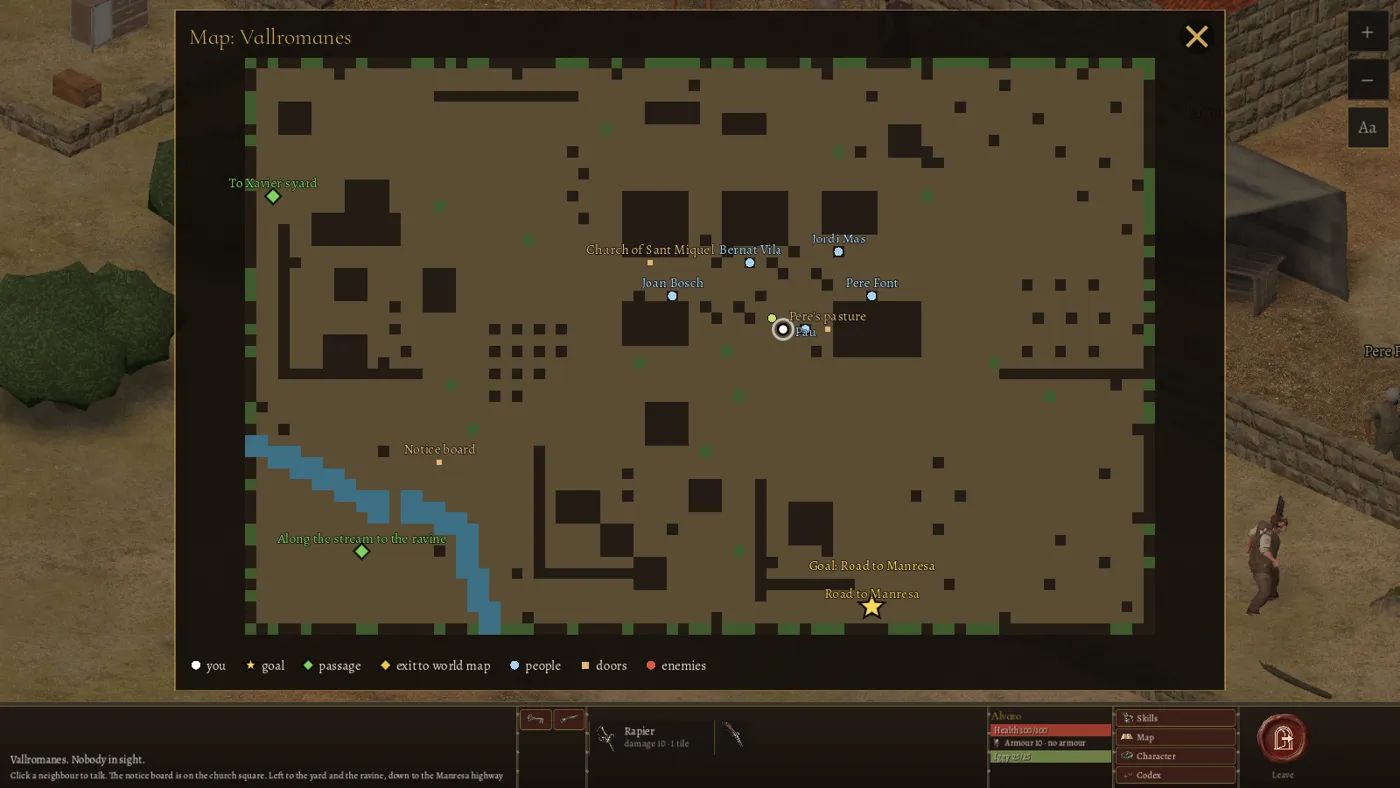
Each place now has its own map in the corner. Open it, and you see yourself, the people you can talk to, doors, exits, and a star for where the story wants you to go. You can walk by clicking on the map.
The place map with people, doors and exits
A tutorial that walks you through
Thirteen short steps with an arrow: fight the wolves, walk, read the map, talk to a neighbor, trade, forge, check the inventory and the wagon, then ride to Manresa and find the family friend in the tavern. The tutorial now waits when a window is open and tells you how to close it, instead of running ahead.
We tested the whole path on a phone screen as well as on desktop.
Next
Licenses for every bought asset, honest sword reach in combat, and the ravine and the grandfather's yard rebuilt to the same standard as the village.